

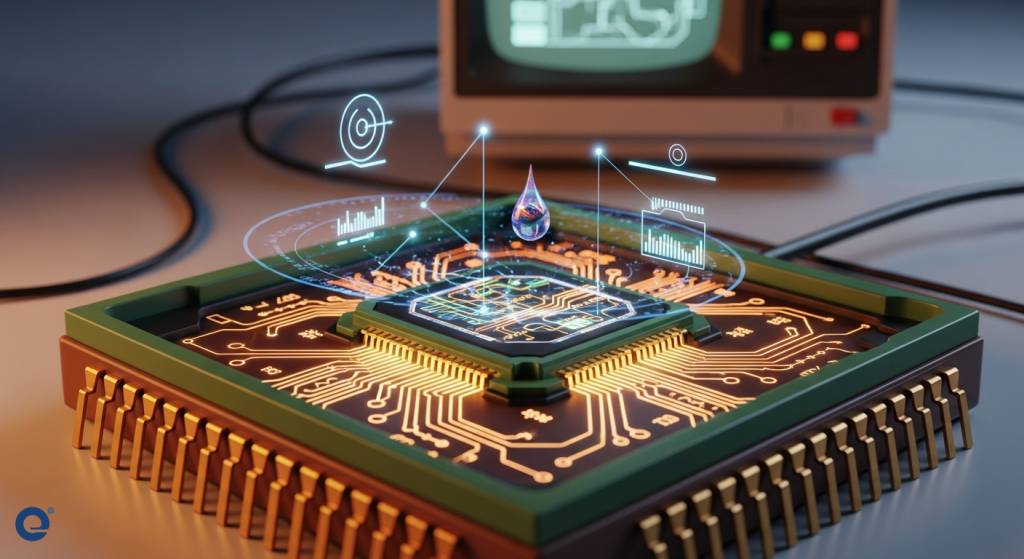
Biochips, often called digital labs-on-chip, are transforming medical diagnostics and research. These miniature devices perform complex biochemical reactions on a small scale. However, their true potential hinges on effective biochip interface design[1]. A well-designed interface ensures usability, accuracy, and broad accessibility. Therefore, innovators in MedTech must prioritize intuitive and robust interfaces. This focus will drive the adoption and impact of biochip technology.
The critical role of user-centric design
Designing biochip interfaces presents unique challenges. Users range from highly trained laboratory technicians to individuals with limited scientific expertise. Consequently, the interface must cater to diverse skill sets. It needs to simplify complex biological protocols. Furthermore, it must provide clear feedback and control over microfluidic operations. Poor design can lead to errors, frustration, and hinder widespread use. Thus, user-centric design principles are paramount.
Effective interfaces bridge the gap between intricate scientific processes and practical application. They translate raw data into actionable insights. This is vital for both research and clinical settings. Ultimately, a superior interface enhances efficiency and reliability. It also accelerates the pace of discovery and patient care.
Democratizing biochip technology with accessible platforms
Traditionally, biochips were confined to specialized laboratories. However, a new movement aims to democratize this technology. Platforms like OpenDrop exemplify this shift. OpenDrop is an integrated electromicrofluidic platform[2]. It allows users to develop and program their own bio-applications. This open-source approach addresses key challenges such as accessibility and bio-protocol design. It also simplifies interaction with microfluidics.
OpenDrop includes a do-it-yourself biochip and automated software. It features a visual interface. This platform has attracted a diverse user base, including makers, academics, and industry professionals. Its success demonstrates the power of accessible design. It shows that personal use of biochips is a tangible future. This development could democratize parts of healthcare, making advanced diagnostics more widely available as highlighted by its creators.
Visualizing complex data for informed decisions
Biochips often generate vast amounts of data. Interpreting this data effectively is crucial for researchers and clinicians. Therefore, advanced visualization tools are essential. One innovative approach is the P-value Glyph Matrix Visualisation. This tool helps biologists evaluate biosensor effectiveness for multi-target biochips[3]. It divides into two representations: a plate view and a matrix view.
The glyph-based visualization[4] uses notable graphics. It helps determine which biosensors best detect and identify analytes. This is achieved by obtaining RGB values and showing t-test results. These results compare biosensors in control environments or exposed to different analytes. This interface helps identify effective biosensors across various exposure times. It significantly aids in designing multi-target biochips as detailed in recent research.
Precision engineering in microfluidic biochip design
Beyond software, the physical design of biochips is equally important. Microfluidic biochips are engineered for precision and efficiency. For instance, a polymeric microfluidic biochip was designed for cytokine enzyme-linked immunosorbent assay (ELISA)[5]. This design aimed to reduce assay time and reagent consumption. It incorporated several new techniques. These included polyaniline-based surface modification for superhydrophobic capillary valving. This also involved oxygen plasma-poly(ethyleneimine)-tyrosinase-protein A modification for high sensitivity protein detection.
The proper flow sequencing was achieved using superhydrophobic capillary valves. This fully automated microfluidic biochip offers high fluorescence signals for ELISA. It provides a wider linear detection range and much shorter assay times than traditional methods. Such innovations are applicable to various non-clinical research and clinically relevant disease conditions according to its developers. These design advancements are critical for the next generation of diagnostic tools.
Key elements of effective biochip interfaces
Several core principles guide successful biochip interface design. Firstly, usability is paramount. Interfaces must be intuitive, minimizing the learning curve for new users. Secondly, clear data visualization transforms complex outputs into understandable information. This supports rapid decision-making. Thirdly, automation and control features streamline experimental workflows. They reduce manual intervention and potential errors.
Furthermore, modularity and open-source principles foster innovation. They allow for customization and community-driven improvements. Finally, robust error handling and feedback mechanisms are essential. They guide users through potential issues. By integrating these elements, MedTech innovators can create powerful and accessible biochip solutions.
The future of MedTech innovation
Thoughtful biochip interface design is not just a technical detail. It is a strategic imperative for MedTech innovators. It unlocks the full potential of these powerful diagnostic tools. From democratizing access to enhancing data interpretation, interfaces are central. They drive efficiency, accuracy, and user adoption. As biochip technology continues to advance, so too must its interfaces. This ensures that these innovations truly benefit humanity.
More information
- Biochip Interface Design: The process of creating the user-facing components and control systems for biochips, focusing on usability, data visualization, and interaction to facilitate biological experiments and diagnostics.
- Electromicrofluidics: A technology that uses electric fields to manipulate fluids and particles at the microscale, often employed in biochips for precise control of samples and reagents.
- Multi-target Biochips: Biochips designed to simultaneously detect or analyze multiple different biological targets or analytes within a single device, increasing throughput and efficiency.
- Glyph-based Visualization: A data visualization technique that uses small, symbolic graphical objects (glyphs) to represent multiple data attributes simultaneously, aiding in the interpretation of complex datasets.
- ELISA (Enzyme-linked immunosorbent assay): A laboratory technique used to detect and quantify specific proteins, antibodies, or other substances in a sample, widely used in medical diagnostics and research.