
Web3 developers are at the forefront of a digital revolution. They are moving beyond the centralized structures of Web2. This shift focuses on creating a more open, secure, and user-centric internet. At the heart of this transformation lie decentralized web protocols[1]. These foundational technologies enable a truly distributed web experience.
Understanding these protocols is crucial for anyone building the next generation of online applications. They offer solutions to many problems inherent in today's internet. Therefore, mastering them is essential for Web3 innovation.
The challenge of Web2's centralization
The current internet, often called Web2, relies heavily on centralized platforms. Companies like Google, Facebook, and Amazon control vast amounts of data and infrastructure. This concentration of power has brought convenience. However, it also introduced significant drawbacks.
For instance, these platforms can censor content. They also dictate terms of service. Furthermore, user data often becomes a commodity. This model raises concerns about privacy and freedom of expression. A report by the MIT Digital Currency Initiative highlights these issues. It notes how a few large platforms influence public information consumption and control online speech. Consequently, many developers seek alternatives.
Web3 aims to address these problems. It proposes a decentralized approach. This means distributing control and data across a network. Therefore, no single entity holds excessive power. This vision requires robust underlying protocols.
What are decentralized web protocols?
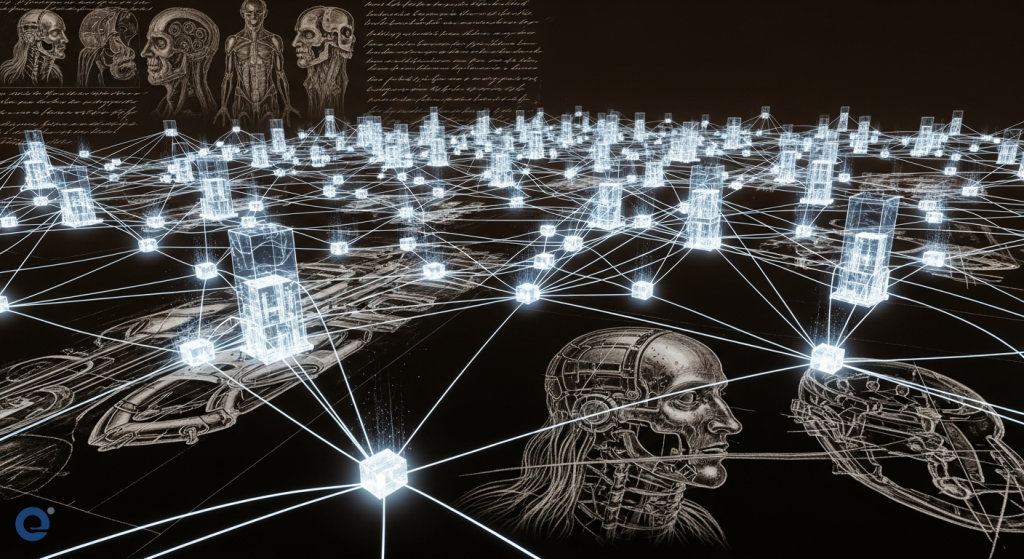
Decentralized web protocols are open standards and technologies. They allow computers to communicate and share data directly. This happens without needing a central server or authority. They form the backbone of the decentralized web. This architecture promotes resilience and censorship resistance.
These protocols often leverage peer-to-peer (P2P) network[2] architectures. In a P2P network, every participant can act as both a client and a server. This contrasts sharply with traditional client-server models. As a result, the network becomes more robust. It also becomes less vulnerable to single points of failure.
Key categories of decentralized protocols
Several types of protocols contribute to the decentralized web. Each addresses a specific aspect of online interaction. Developers can combine these to build complex Web3 applications. Here are some prominent examples:
1. Distributed storage protocols
These protocols enable users to store data across a network of computers. This eliminates reliance on a single cloud provider. The InterPlanetary File System (IPFS)[3] is a leading example. It allows content-addressable storage. This means data is retrieved based on its content, not its location. Hypercore Protocol is another fast and scalable P2P protocol for data sharing. These systems enhance data persistence and censorship resistance.
2. Decentralized communication protocols
Secure and private communication is vital for Web3. Protocols like Matrix offer an open standard for decentralized, persistent communication. Nostr provides a simple, open protocol for censorship-resistant social networks. Scuttlebutt is another offline-friendly secure gossip protocol. These tools empower developers to build communication features without central intermediaries.
3. Identity and data ownership protocols
Web3 emphasizes user control over their data and identity. Protocols like Blockstack provide a decentralized internet with developer tools for dApps. Solid, proposed by Tim Berners-Lee, aims to decouple data from applications. It allows users to store their data in personal online data stores (PODs). Webnative is a JavaScript library that helps achieve this. These protocols give users true data provenance[4].
4. Decentralized social networking protocols
Moving social interactions away from corporate control is a major goal. ActivityPub[5] is an open, decentralized social networking protocol. It powers federated platforms like Mastodon. ForgeFed provides a decentralized federation protocol for development workflows. These protocols foster interoperability between different social platforms. This allows users to move their social graph more easily.
Benefits for Web3 developers
Adopting decentralized web protocols offers numerous advantages for Web3 developers. These benefits directly align with the core principles of a decentralized internet.
- Censorship resistance: Applications built on these protocols are harder to shut down. No single entity can remove content or block access. This ensures greater freedom of expression.
- Enhanced data privacy and ownership: Users retain control over their data. They decide who accesses it and how. This reduces the risk of data breaches and misuse by large corporations.
- Interoperability: Open standards allow different applications to communicate seamlessly. This fosters a more connected and less fragmented digital ecosystem. Developers can build on existing protocols.
- Reduced vendor lock-in: Developers are not tied to a single platform or service provider. They can switch components or services more easily. This promotes innovation and competition.
- Community-driven development: Many decentralized protocols are open-source. This encourages community contributions and transparency. Developers can collaborate globally.
Challenges and future outlook
Despite their promise, decentralized web protocols face challenges. Scalability remains a significant hurdle for many. Ensuring a smooth user experience is also critical for mass adoption. Furthermore, the regulatory landscape for decentralized technologies is still evolving.
However, the community of experimenters is robust and fertile. Many projects are developing promising software. Easy-to-use, peer-to-peer distributed storage systems are changing the landscape for content censorship and archiving. There is also renewed interest in creating interoperable standards. This will allow protocols to cross platforms. The IEEE highlights blockchain networks and protocol innovation as key to Web 3.0 for the decentralized web.
The future of the decentralized web looks bright. Continuous innovation addresses these challenges. Developers are actively building more efficient and user-friendly solutions. Therefore, the ecosystem is maturing rapidly. The GitHub repository lists many decentralized services and technologies available today.
Conclusion
Decentralized web protocols are fundamental to the Web3 vision. They empower developers to build applications that are resilient, private, and open. By understanding and utilizing these protocols, developers can contribute to a more equitable internet. This shift represents a significant step forward. It moves towards a web where users truly own their data and control their digital lives. The journey is ongoing, but the foundation is firmly laid.
More Information
- Decentralized Web Protocols: These are open, peer-to-peer standards and technologies that enable communication and data sharing across a network without relying on a central authority or server.
- Peer-to-peer (P2P) network: A distributed network architecture where each node (computer) can function as both a client and a server, directly communicating with other nodes without a central intermediary.
- InterPlanetary File System (IPFS): A distributed system for storing and accessing files, websites, applications, and data. It uses content addressing to retrieve data based on its unique hash, rather than its location.
- Data provenance: The record of where data came from and how it was processed. In decentralized systems, it refers to the ability for users to track and verify the origin and history of their digital information.
- ActivityPub: An open, decentralized social networking protocol that allows different social applications to interoperate. It enables users to follow, interact, and share content across various federated platforms.