
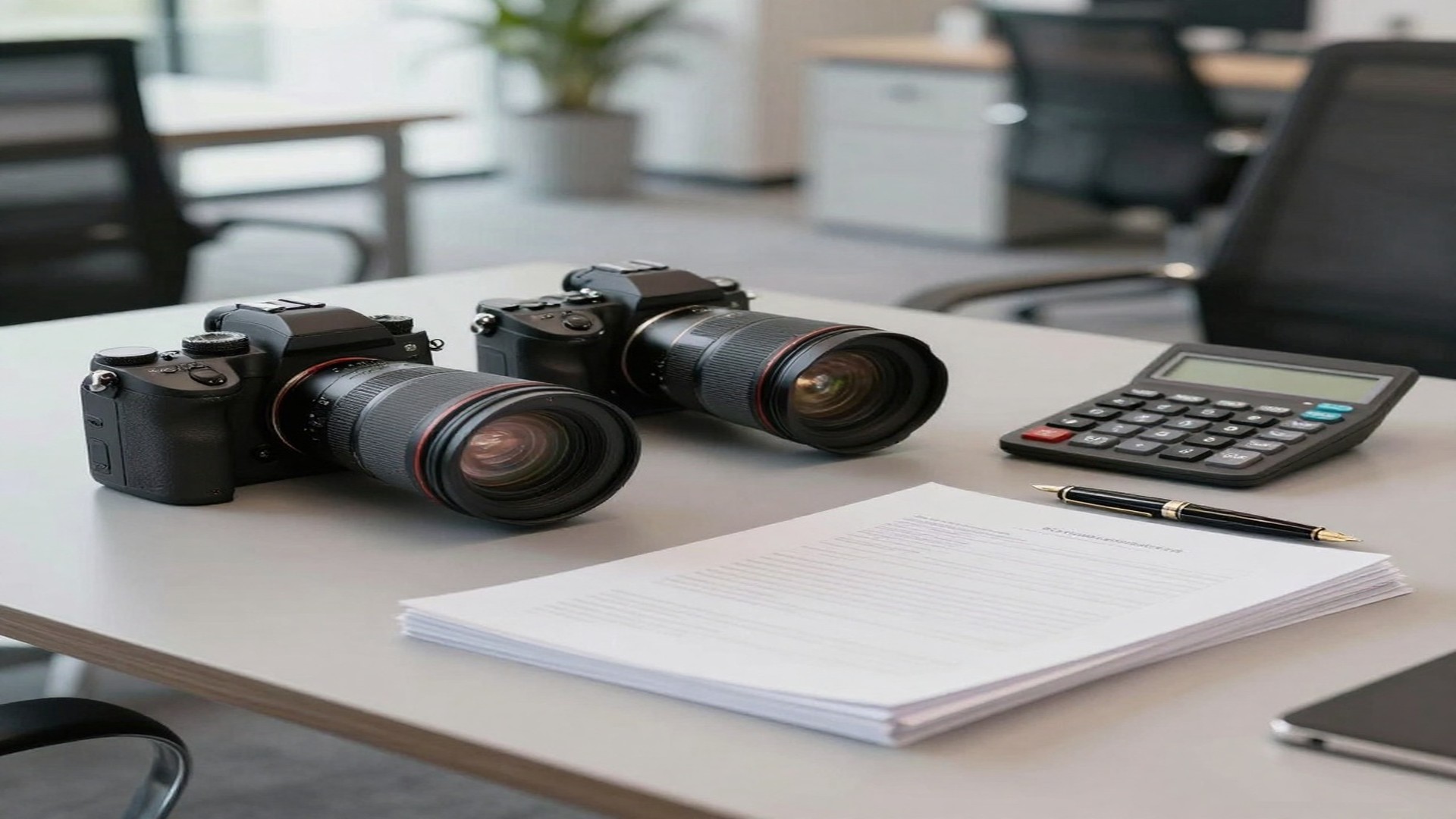
The Boom of the Content Creation Industry and the Investment Cost Challenge
In today’s digital era, video has become the dominant media format. From professional media companies to small businesses looking to build TikTok or YouTube channels, investing in modern filming equipment is essential. However, a full set of equipment including cameras, lenses, LED lights, gimbals, and recording devices can cost from tens of millions to billions of VND. This poses a major question for business owners and accountants: Are filming equipment purchase costs tax-deductible?
Understanding tax regulations not only helps businesses comply with the law but is also a way to optimize cash flow and reduce the financial burden when reinvesting in technology. If you are wondering whether those expensive Sony or Canon cameras and lighting kits are considered deductible expenses when finalizing Corporate Income Tax (CIT), this article will provide the most detailed answer.
In fact, according to current Vietnamese tax laws, most expenditures for equipment serving production and business activities have the opportunity to be deducted. However, for “Are filming equipment purchase costs tax-deductible?” to become a reality, businesses must meet a series of strict standards regarding invoices, documents, and purpose of use. Let’s delve into the specific conditions below.
Conditions for Filming Equipment Costs to be Considered Deductible Expenses
For a filming equipment purchase to be deducted when calculating CIT, businesses must ensure three basic conditions according to Circular 96/2015/TT-BTC:
1. Directly related to production and business activities
This is a prerequisite. The business must prove that the purchase of cameras, tripods, or studio equipment is to serve the generation of revenue. For example:
- A company specializing in Media or a Production House buys cameras to film for clients.
- A retail company buys equipment to produce its own product advertisement videos and sales livestreams.
- A training center buys equipment to record online lectures.
If a business operates in the construction sector but buys an expensive Leica camera set without any related communication activities, the tax authorities have the right to question and exclude this expense.
2. Sufficient legal invoices and documents
Every transaction must be reflected through a Value Added Tax (VAT) invoice or a sales invoice (if purchased from a household business). The information on the invoice, such as company name, tax code, and address, must be absolutely accurate. In addition to the invoice, businesses need to keep accompanying documents such as:
- Sales contracts (for large equipment packages).
- Equipment handover minutes.
- Warranty cards or user manuals.
3. Non-cash payment documents
For filming equipment invoices valued at 20 million VND or more (price including VAT), businesses are required to make payments via bank transfer. If payment is made in cash for invoices over 20 million VND, this expense will be immediately excluded from deductible expenses, and the business will also not be allowed to deduct the input VAT.
Classifying Filming Equipment: Fixed Assets or Tools and Supplies?
The method of accounting and tax deduction will vary depending on the value of the equipment. Proper classification helps businesses allocate costs scientifically.
Equipment as Fixed Assets (FA)
According to Circular 45/2013/TT-BTC, filming equipment is considered a fixed asset if it simultaneously satisfies three criteria:
- Economic benefits are certain to be obtained in the future from the use of the asset.
- It has a useful life of 01 year or more.
- The historical cost is reliably determined and has a value of 30,000,000 VND or more.
For cinema camera lines like RED, ARRI, or high-end Mirrorless lines combined with Cine lenses, the value often far exceeds 30 million VND. In this case, the business cannot deduct the entire cost in one accounting period but must perform monthly/annual depreciation according to the regulated framework (usually from 3 to 15 years depending on the type).
Equipment as Tools and Supplies
If filming equipment (such as interview microphones, small LED lights, standard tripods) has a value of less than 30,000,000 VND, they are considered tools and supplies. Businesses can choose to:
- Allocate 100% to expenses in the month of purchase (if the value is small).
- Allocate gradually over the actual time of use but not exceeding 3 years.
This allocation helps businesses be more flexible in regulating profits and taxes payable in the short term.
Special Cases to Note
Buying used filming equipment
The market for used filming equipment is very active. For the cost of buying used machines to be tax-deductible, the business still needs an invoice. If buying from another business, they must issue a VAT invoice to you. If buying from an individual, the business needs to prepare a set of documents including: A sales contract, handover minutes, and a list of purchased goods and services without invoices (Form No. 01/TNDN) accompanied by the seller’s ID card/citizen identification card.
Buying equipment from abroad (Import)
If you order equipment from international websites such as B&H or Adorama, the set of documents to be tax-deductible includes: Customs declaration, proof of payment of VAT on imported goods, proof of payment of import tax (if any), and international payment documents via bank.
Benefits of Properly Accounting for Filming Equipment Costs
When understanding the rule “Are filming equipment purchase costs tax-deductible?”, businesses will receive practical benefits:
- Reduce CIT payable: With the current CIT rate of 20%, for every 100 million VND of deductible expenses, the business saves 20 million VND in tax.
- Input VAT deduction: Businesses are refunded or offset the amount of VAT (usually 10%) paid when purchasing equipment, helping to reduce the actual investment cost.
- Financial transparency: Keeping full documentation helps businesses be confident when tax inspection teams visit, avoiding unnecessary administrative penalties.
Conclusion
In summary, the answer to the question “Are filming equipment purchase costs tax-deductible?” is a resounding YES, as long as the business complies with the regulations on the reasonableness, legality, and validity of documents. Investing in equipment is not only an upgrade in image quality but also a financial strategy if you know how to take advantage of tax incentives.
To ensure optimization of benefits, business owners should consult with accounting experts or professional tax advisory units before making large purchase packages. Careful preparation right from the purchasing stage will help you focus on creating “million-view” footage without worrying about future tax audit issues.