
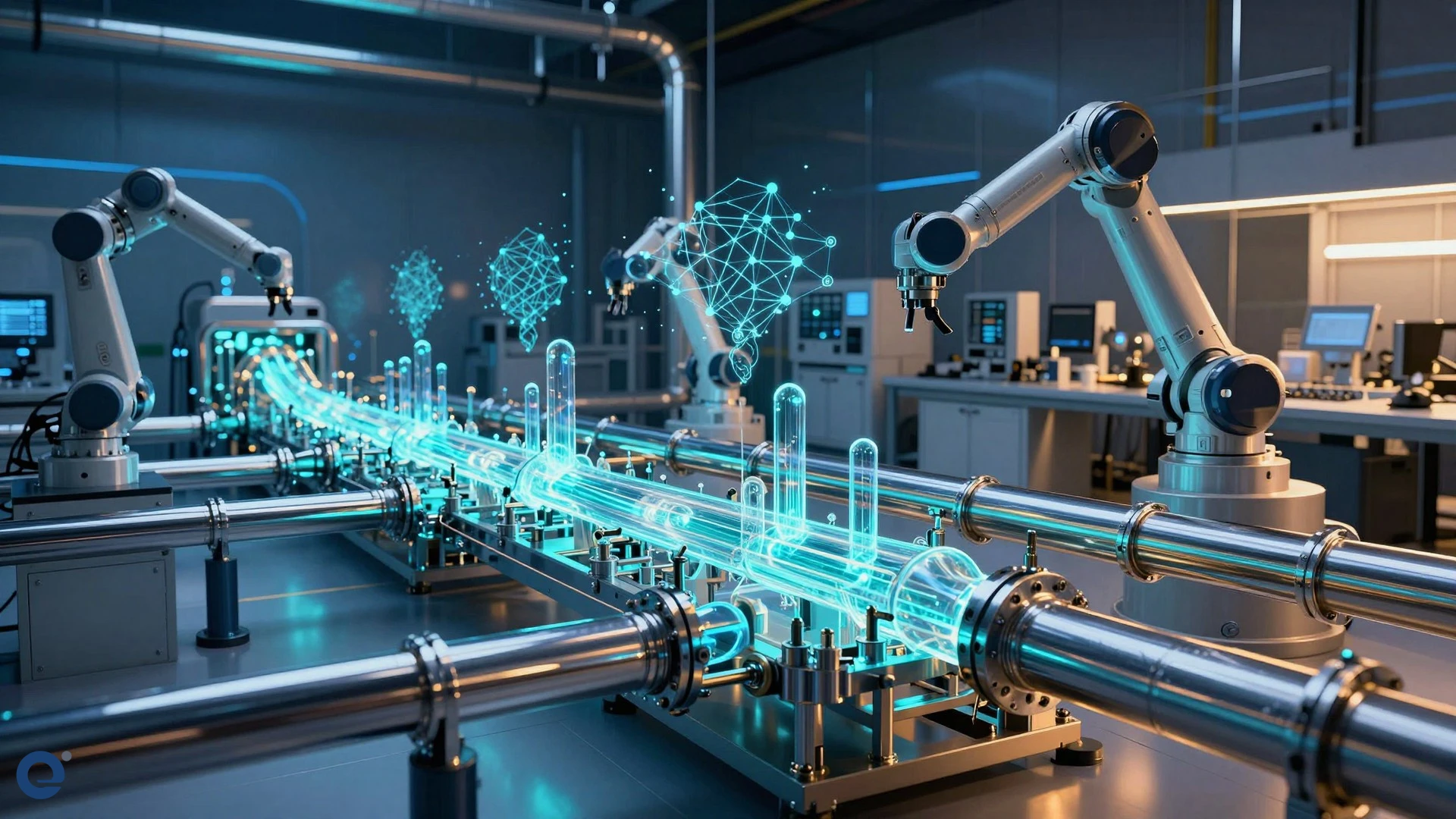
Traditional scientific discovery follows a linear trajectory built on human intuition. Researchers formulate hypotheses based on past literature, test assumptions in laboratories, and iteratively refine theories. Consequently, human cognitive limits and domain biases frequently constrain the boundaries of scientific inquiry. Scientists often spend entire careers exploring narrow, familiar conceptual landscapes.
Artificial intelligence fundamentally disrupts this traditional scientific paradigm. Advanced machine learning models explore vast, multidimensional parameter spaces far beyond human cognitive capacity. As a result, AI systems identify unexpected relationships, novel molecular structures, and non-intuitive physical patterns. These discoveries emerge not from pre-programmed instructions, but from data-driven synthesis across disparate domains.
This dynamic shifts artificial intelligence from a simple speed booster to a primary discovery engine. For venture capitalists and R&D directors, this evolution requires a complete structural transformation. Capital allocators must look beyond incremental efficiency tools and instead invest in platforms capable of generating serendipitous scientific leaps.

Beyond linear hypothesis testing: why non-human pattern recognition changes science
Legacy research frameworks rely heavily on domain-specific expertise. However, human experts inevitably suffer from confirmation bias and institutional blind spots. Researchers naturally design experiments around existing literature and established theoretical frameworks. Therefore, highly novel breakthroughs remain rare because conventional scientific methodology discourages high-risk exploration.
AI models operate without these cognitive constraints. Deep neural networks analyze millions of uncurated datasets simultaneously across biological, chemical, and physical parameters. Consequently, machine models surface candidate molecules and materials that traditional hypothesis testing would ignore completely. For instance, pioneering platforms like EON Tech demonstrate how integrated data architectures allow enterprise research teams to synthesize unstructured data faster than legacy scientific tools.
Furthermore, machine learning transforms predictive science into generative discovery. Algorithms do not merely validate existing theories; they propose entirely new chemical formulations and biological mechanisms. Leading international research institutions now deploy machine-driven pipelines to map uncharted search spaces [1]. You can analyze how modern educational and innovation hubs integrate AI into fundamental scientific research through ecosystem development initiatives aimed at empowering young innovators.
The strategic dilemma for R&D directors: incremental speed versus paradigm shifts
R&D directors face a critical strategic choice when integrating artificial intelligence. Most enterprise leaders deploy AI primarily as an operational automation tool. They use algorithms to automate lab benchwork, speed up documentation, or optimize existing manufacturing protocols. However, this narrow perspective treats AI merely as a cost-reduction utility rather than a strategic catalyst.
The true economic value of AI lies in radical paradigm shifts. Enterprise research programs must transition from deterministic experimentation to probabilistic exploration. This shift requires corporate leaders to accept higher model uncertainty in exchange for non-obvious scientific discoveries. The following comparison highlights the operational differences between traditional automation and catalyst-driven AI deployment:
- Traditional Automation (Efficiency Focus): Speeds up known test protocols, reduces manual labor, targets linear optimization, and operates strictly within established domain models.
- Catalyst AI (Discovery Focus): Uncovers unpredicted scientific phenomena, generates novel scientific hypotheses, navigates high-dimensional data, and synthesizes cross-disciplinary knowledge.
- Resource Allocation: Shifting capital from legacy test rigs to unified data lakes, compute infrastructure, and cross-domain machine learning models.
Strategic policy frameworks increasingly prioritize this transformation. National technology mandates explicitly classify artificial intelligence, big data, and cloud infrastructure as strategic foundational technologies [2]. Enterprise leaders must align corporate R&D strategies with state-level policies by exploring strategic AI infrastructure initiatives that position data governance at the center of national competitiveness.
National strategy as an incubator for unexpected breakthroughs
Scientific breakthroughs rarely occur in isolation. Instead, unforeseen discoveries require robust national ecosystems backed by targeted public policy, computational infrastructure, and institutional talent pipelines. When governments establish clear legal frameworks and digital infrastructure, private enterprise investment accelerates dramatically.
For example, national initiatives like Resolution 57 establish AI research and development as a central engine for long-term economic competitiveness [2]. Such policies create national data-sharing mechanisms, unified digital governance models, and high-tech innovation zones. As a result, research institutions gain access to standardized data repositories necessary for training complex scientific algorithms.
Moreover, building core technology independence remains crucial for sustainable scientific discovery. Developing localized AI capabilities ensures national scientific autonomy and protects intellectual property [3]. R&D leaders can leverage open AI models as a catalyst for edge computing to establish localized computational hubs. Global academic leaders emphasize that mastering underlying algorithms through advanced postgraduate training creates long-term research resilience across critical scientific disciplines[3].
The capital allocation playbook: a four-stage framework for venture capitalists
Venture capitalists evaluating AI-native scientific startups cannot use standard SaaS metrics. Software subscription growth and customer acquisition costs fail to capture deep-tech potential. Instead, investors need a specialized decision framework tailored to algorithmic discovery engines. Industry leaders describe AI adoption as a massive 10x leap in national and enterprise productivity [4]. Venture capitalists must evaluate opportunities across four sequential evaluation criteria:
- Data Sovereignty and Pipeline Uniqueness: Does the startup possess proprietary, high-quality domain datasets, or do they rely on public training sets? Sustainable breakthroughs require defensible data moats.
- Interdisciplinary Human Talent: Does the founding team combine machine learning expertise with deep domain science? Algorithms require validation by scientists who understand physical domain constraints [3].
- Algorithmic Autonomy: Can the AI system generate testable hypotheses autonomously, or does it merely summarize existing literature? True enterprise value resides in generative discovery.
- Scalable Validation Infrastructure: Has the venture integrated automated robotic labs to test machine-generated hypotheses in real time? Digital suggestions must translate rapidly into empirical physical validation.
Economic projections indicate that widespread AI integration could contribute up to 12 percent of national gross domestic product by 2030 [4]. Investors can examine detailed economic forecasts by reviewing global advancement reports outlining enterprise AI investment patterns and market trajectories.
Managing systemic risks in machine-driven discovery
Despite its vast potential, machine-driven discovery presents unique operational and ethical risks. AI models frequently produce false positives or hallucinate plausible-sounding scientific theories. If researchers blindly trust algorithmic outputs, enterprise labs risk wasting millions of dollars validating flawed machine recommendations.
Furthermore, black-box AI architectures obscure how algorithms arrive at specific conclusions. In fields like pharmaceutical development or aerospace engineering, opaque decision-making creates unacceptable regulatory risks. R&D directors must implement strict human-in-the-loop oversight to verify algorithmic findings before committing physical capital.
Organizationally, deploying unconstrained AI systems without strict operational guardrails introduces governance friction. Leaders must actively mitigate systemic failures by studying lessons from high-stakes deployments. For instance, tech teams often study protocols for designing life-critical AI constitutions for high-stakes environments to balance machine autonomy with mandatory human friction. Equipping scientific workforces with comprehensive digital and AI competency frameworks ensures safe, effective integration [1], [5].
Re-engineering leadership for the algorithmic laboratory
Artificial intelligence is fundamentally reshaping the economics of scientific research. By breaking free from linear human thinking, algorithmic models uncover unexpected breakthroughs across medicine, material science, and clean energy. However, hardware compute and sophisticated models represent only part of the equation.
Capturing this value requires courageous leadership from venture capitalists and corporate directors. Capital must flow away from incremental software utilities toward interdisciplinary discovery platforms. Organizations must rebuild their talent infrastructure, modernizing higher education and postgraduate training to produce hybrid scientist-engineers [3].
Ultimately, artificial intelligence will not replace human scientists. Instead, researchers who harness AI discovery engines will replace those who do not. Enterprise leaders who embrace this shift today will define the next century of scientific and economic advancement.
More information
- Human-Centred AI Ecosystem: A policy and technical framework prioritizing human welfare, safety, digital sovereignty, and ethical alignment in AI deployment.
- Strategic Technologies List: National legislative classifications identifying critical high-value technologies, including AI, big data, semiconductors, and quantum computing.
- Core Technology Mastery: Developing foundational algorithmic architectures, models, and hardware domestically rather than relying solely on foreign software solutions.
- 10x Productivity Leap: Exponential growth in systemic output achieved by integrating autonomous AI workflows across enterprise R&D pipelines.
- Digital Competency Framework: Structured national guidelines designed to upskill educators, students, and researchers in practical artificial intelligence competencies.