

Financial markets move at an incredible pace. Therefore, staying ahead requires precision and speed. For quantitative analysts, algorithmic trading bots[1] have become indispensable tools. They automate complex strategies. This allows for faster execution and removes human emotion from trading decisions.
This article explores the world of algorithmic trading bots. We will cover their core concepts and key features. We will also discuss various strategies and their profitability. Furthermore, we will examine the role of open-source platforms and artificial intelligence in this evolving field. Our goal is to provide a comprehensive overview for quants looking to leverage these powerful systems.
What are algorithmic trading bots?
Algorithmic trading bots are automated systems. They perform trades based on pre-set rules, strategies, and technical indicators. For example, a bot might buy when a short-term moving average crosses above a long-term one. It can also react to volume spikes. These bots are designed to make decisions and execute trades much faster than humans. They also eliminate emotional biases, which often lead to poor trading choices.
The core idea is to follow parameters systematically. Bots manage risk efficiently. They react instantly to market changes. This ensures optimal execution. Algorithmic crypto trading bot development uses financial markets and computer programming to execute deals at exact times. This approach ensures efficiency.
Key features and advantages
Algorithmic trading bots offer several distinct advantages. These benefits are crucial for quantitative analysts.
- Speed: Bots execute trades in milliseconds. They react to market changes instantly. This speed is impossible for human traders to match.
- Efficiency: Bots handle routine and repetitive tasks. They scan markets for opportunities. They execute orders accurately without manual intervention. This frees up analysts for higher-level tasks.
- Emotion-free: Bots rely solely on programmed strategies. They avoid human emotions like fear and greed. This leads to more consistent and objective decision-making.
These features combine to create a powerful trading mechanism. They enhance a trader's ability to capitalize on market movements. Moreover, they ensure disciplined strategy adherence.
Types of algorithmic trading strategies
Various strategies can be automated using trading bots. Each strategy targets different market conditions and opportunities.
- Market-making[3]: Traders place both buy and sell orders at different price levels. They profit from the spread between them. Hummingbot, for instance, supports this strategy across various markets.
- Arbitrage[4]: This involves buying an asset in one market at a lower price. Then, it is sold in another market at a higher price. The goal is to exploit price differences. This requires extremely fast execution.
- Trend-following: Bots identify and follow market trends. They buy when prices are rising and sell when they are falling. This strategy assumes that past trends will continue.
- Mean reversion: This strategy assumes that prices will eventually return to their average. Bots buy when prices are low and sell when they are high, expecting a return to the mean.
These strategies can be complex. They often combine multiple indicators. This allows for robust decision-making. Automating your trading strategy with these bots can significantly enhance performance.
Profitability and optimization
The profitability of algorithmic trading bots varies widely. It depends on several factors. These include the quality of the strategy, market conditions, and the software used. A quant trading bot might perform well in stable markets. However, it could struggle during high volatility if not designed to adapt. Traders see consistent results when bots are paired with real-time data. Clear rules for risk management are also essential. Profitability improves when bots automate an already proven strategy. They are tools, not magic solutions that find trades on their own.
Optimizing trading efficiency is key. Bots perform best when combined with real-time market analysis tools. Tools like Bookmap offer deep visual analysis of market liquidity and order book data. This information helps fine-tune bot strategies. It also improves decision-making accuracy. Therefore, continuous monitoring and adjustment are vital for sustained success.
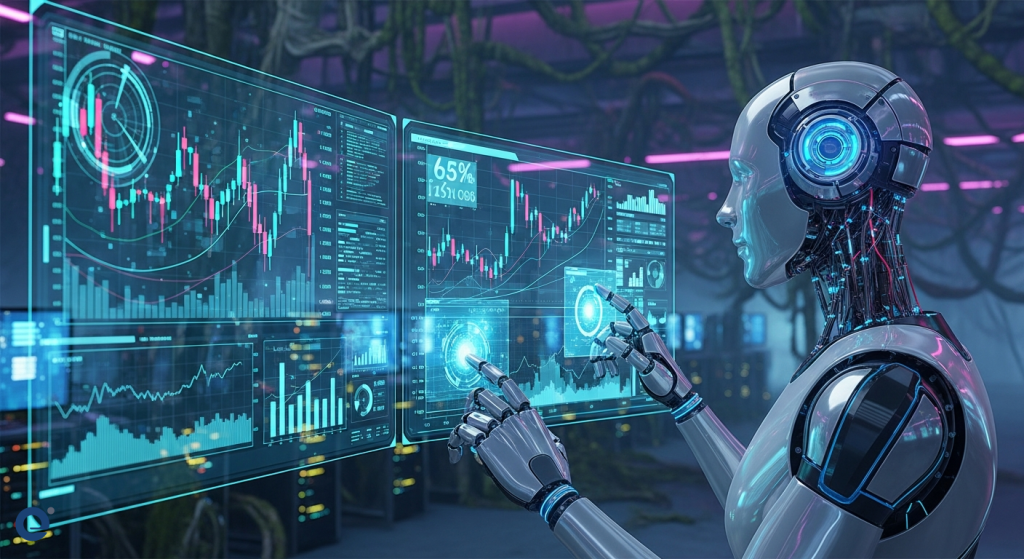
Open-source and AI-powered bots
The landscape of algorithmic trading is rapidly evolving. Open-source platforms are gaining popularity. Hummingbot is an example. It is an open-source trading bot. It automates strategies in cryptocurrency, futures, and traditional assets. Its open nature allows customization. Developers can modify the code. They can also contribute to its continuous improvement. This fosters innovation within the community.
Artificial intelligence (AI) and machine learning[5] are also transforming bot capabilities. Traditional bots rely on preset rules. However, AI-powered bots can evaluate enormous datasets. They adapt to shifting market trends. This offers new levels of predictive power and flexibility. Projects like Qlib and FinRL, found on platforms like GitHub for algorithmic trading, showcase this trend. They integrate AI to empower quantitative research. This includes supervised learning and reinforcement learning. Such advancements are pushing the boundaries of what trading bots can achieve.
The integration of AI agents is also becoming more prevalent. These agents can learn and adapt. They optimize trading strategies over time. This makes them highly valuable for complex market environments. For more insights into this area, consider exploring AI agents: The future growth for SaaS founders. This highlights the broader impact of AI in automation.
Challenges and future outlook
Despite their advantages, algorithmic trading bots present challenges. Backtesting is crucial but can be complex. Overfitting a strategy to historical data is a common pitfall. Market microstructure also plays a significant role. Bots must adapt to changing market conditions. Continuous monitoring and maintenance are essential. Without them, performance can degrade rapidly.
The future of algorithmic trading bots is bright. Further integration of advanced AI and machine learning is expected. This will lead to more sophisticated and adaptive strategies. The focus will remain on speed, efficiency, and risk management. Quantitative analysts will continue to play a pivotal role. They will design, optimize, and oversee these intelligent trading systems. The goal is to harness technology for superior market performance.
More Information
- Algorithmic Trading: A method of executing orders using automated pre-programmed trading instructions. These instructions consider variables like time, price, and volume to make trading decisions.
- Quantitative Analyst: A professional who applies mathematical and statistical methods to financial and risk management problems. They often develop and implement complex financial models and trading strategies.
- Market-Making: A trading strategy where a trader simultaneously places both buy and sell orders for a financial instrument. The goal is to profit from the bid-ask spread.
- Arbitrage: The practice of simultaneously buying and selling an asset in different markets to profit from a temporary difference in its price. This requires rapid execution to capture fleeting opportunities.
- Machine Learning: A subset of artificial intelligence that enables systems to learn from data, identify patterns, and make decisions with minimal human intervention. In trading, it helps bots adapt to market changes.