
Smart cities require advanced tools to manage complex urban environments. Therefore, digital twin factories are emerging as a pivotal solution. They offer unprecedented capabilities for urban planners. These virtual replicas of physical factories allow for precise monitoring and optimization. Ultimately, they enhance urban infrastructure and resource management.
What are digital twin factories?
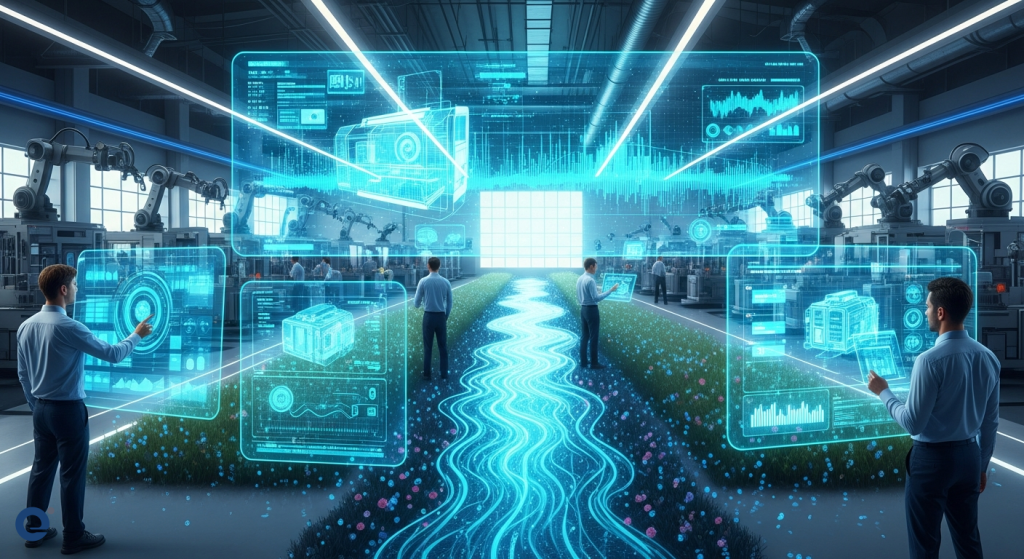
A digital twin[1] is a virtual replica of a physical object or system. In manufacturing, this concept extends to entire production processes. Manufacturers use these replicas to monitor, analyze, and optimize operations. They can do this without costly physical trials (Source 1). This dynamic representation mirrors a physical plant. It provides a virtual sandbox for innovation. Smart city planners can thus understand the intricate workings of industrial sites within their jurisdiction.
The evolution of digital twins
The concept of digital twins began in the early 2000s. Initially, it focused on product lifecycle management (Source 1). However, its scope has expanded significantly. The Industry 4.0[2] revolution accelerated this growth. This era emphasizes interconnectivity, automation, and real-time data. Consequently, companies now leverage digital twins for agile and efficient production environments. This trend is vital for cities aiming for advanced industrial integration.
Key technologies powering digital twins
Digital twins do not operate in isolation. Instead, they integrate with various cutting-edge technologies (Source 1). The Internet of Things (IoT)[3] provides real-time data. Sensors and connected devices feed this information into the digital twin. Furthermore, Artificial Intelligence (AI) and Machine Learning (ML) algorithms analyze this vast data. They offer predictive insights and enable automated decision-making. Virtual Reality (VR) also allows immersive interaction with the twin. This facilitates better understanding of processes. Therefore, a robust data ecosystem is crucial for these integrations.
Beyond digital: The virtual twin concept
The concept of a Virtual Twin[4] takes this further. It goes beyond a static digital representation (Source 2). A virtual twin models, simulates, and visualizes every aspect of manufacturing. This includes products, processes, plant layouts, and logistics. It even covers supply chain execution. This dynamic, data-driven representation provides bidirectional feedback. It creates a tightly connected design-to-manufacturing loop. For instance, DELMIA's Virtual Twin for Manufacturing drives sustainability, innovation, and profitability. This holistic view is invaluable for smart city planning.
Optimizing urban infrastructure with digital twin factories
Smart city planners can significantly benefit from these advanced tools. Digital twin factories allow them to simulate the impact of industrial operations on urban resources. This includes energy consumption, water usage, and waste generation. By identifying hotspots, targeted reduction measures become possible (Source 2). This proactive approach supports sustainable urban development. Moreover, it helps in planning city services around industrial needs. Digital twin technology can also revolutionize logistics within a city.
Enhancing sustainability and efficiency
Digital twin factories are powerful tools for sustainability. They help reduce waste and carbon footprint (Source 2). By maximizing product output per time period, efficiency increases. Predictive maintenance for factory equipment also reduces downtime. This minimizes resource waste. For example, digital twins in manufacturing streamline processes. This leads to higher quality and reduced scrap. Such efficiencies contribute directly to a city's environmental goals.
The rise of AI factory digital twins
The development of AI factories introduces a new dimension. NVIDIA's Omniverse Blueprint for AI factory digital twins is a prime example (Source 3). This blueprint allows engineers to design, simulate, and optimize entire AI factories. These virtual environments are physically accurate. They enable early issue detection and smarter facility development. The system uses Universal Scene Description (OpenUSD)[5] for detailed 3D and simulation data (Source 3). It unifies power, cooling, and networking components. NVIDIA's expansion of Omniverse Blueprint highlights this critical trend. Such specialized factories are becoming integral to smart city digital infrastructure. Furthermore, sustainable data centers are crucial for supporting these AI factories.
Benefits for smart city planners
Digital twin factories offer numerous advantages for urban planners. They provide a robust framework for future development. Key benefits include:
- Informed Decision-Making: Planners can test various urban development scenarios virtually.
- Resource Optimization: Better management of energy, water, and logistical flows within industrial zones.
- Sustainability Goals: More effective achievement of environmental targets through optimized factory operations.
- Economic Resilience: Support for local industries and prediction of supply chain disruptions.
- Infrastructure Planning: Precise design of city services to accommodate industrial growth.
- Risk Reduction: Identification of potential issues before physical implementation, saving time and costs.
Challenges and future outlook
Implementing digital twin factories is not without challenges. Data integration can be complex (Source 1). There is also a need for standardized "SimReady" assets (Source 3). Investment in compatible platforms is essential. However, the long-term benefits far outweigh these initial hurdles. Digital twin factories are rapidly becoming indispensable. They are a cornerstone for modern urban planning and smart city development.
Conclusion
Digital twin factories represent a transformative leap for smart cities. They offer unprecedented insights and control over industrial operations. By leveraging these advanced virtual models, smart city planners can build more efficient, sustainable, and resilient urban environments. This technology empowers cities to innovate and thrive in the digital age. Ultimately, digital twin factories are crucial for shaping the future of urban living.
More Information
- Digital Twin: A virtual model designed to accurately reflect a physical object, process, or system. It uses real-time data to simulate behavior and predict outcomes.
- Industry 4.0: The ongoing automation of traditional manufacturing and industrial practices, using smart technology. It emphasizes interconnectivity, automation, machine learning, and real-time data.
- Internet of Things (IoT): A network of physical objects embedded with sensors, software, and other technologies. These devices connect and exchange data over the internet.
- Virtual Twin: An advanced form of a digital twin that goes beyond mere replication. It models, simulates, and visualizes every aspect of a system, including processes and supply chains, with bidirectional feedback.
- Universal Scene Description (OpenUSD): An open-source 3D scene description technology developed by Pixar. It provides a robust framework for composing, simulating, and collaborating on 3D data.