
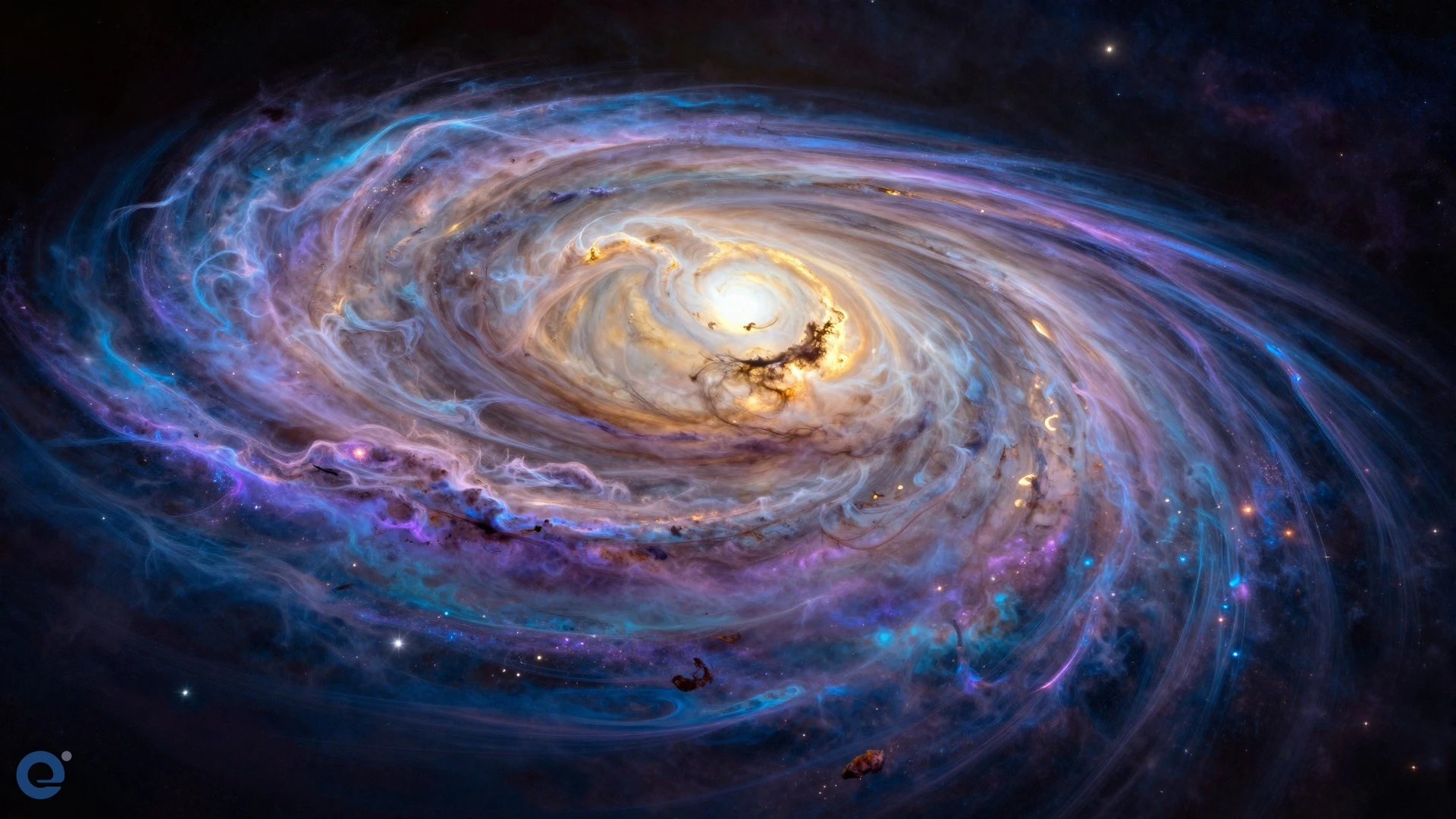
The vast, cold reaches of space are often perceived as static voids, yet they are roiling with complex motion. Planetary scientists rely on the Navier-Stokes equations to decode the chaotic dance of interstellar gas and the intricate formation of protoplanetary disks. This modeling is not merely an academic exercise; it is the fundamental framework for understanding how stars and planets emerge from the primordial soup of the galaxy.
While traditional fluid mechanics assumes a continuous medium, space environments frequently challenge these assumptions with vacuum conditions and zero-gravity variables. The precision of our models determines our ability to predict the life cycles of solar systems. EON Tech has recently integrated these high-fidelity simulations into their research pipeline to better visualize the thermal instabilities that govern star formation.
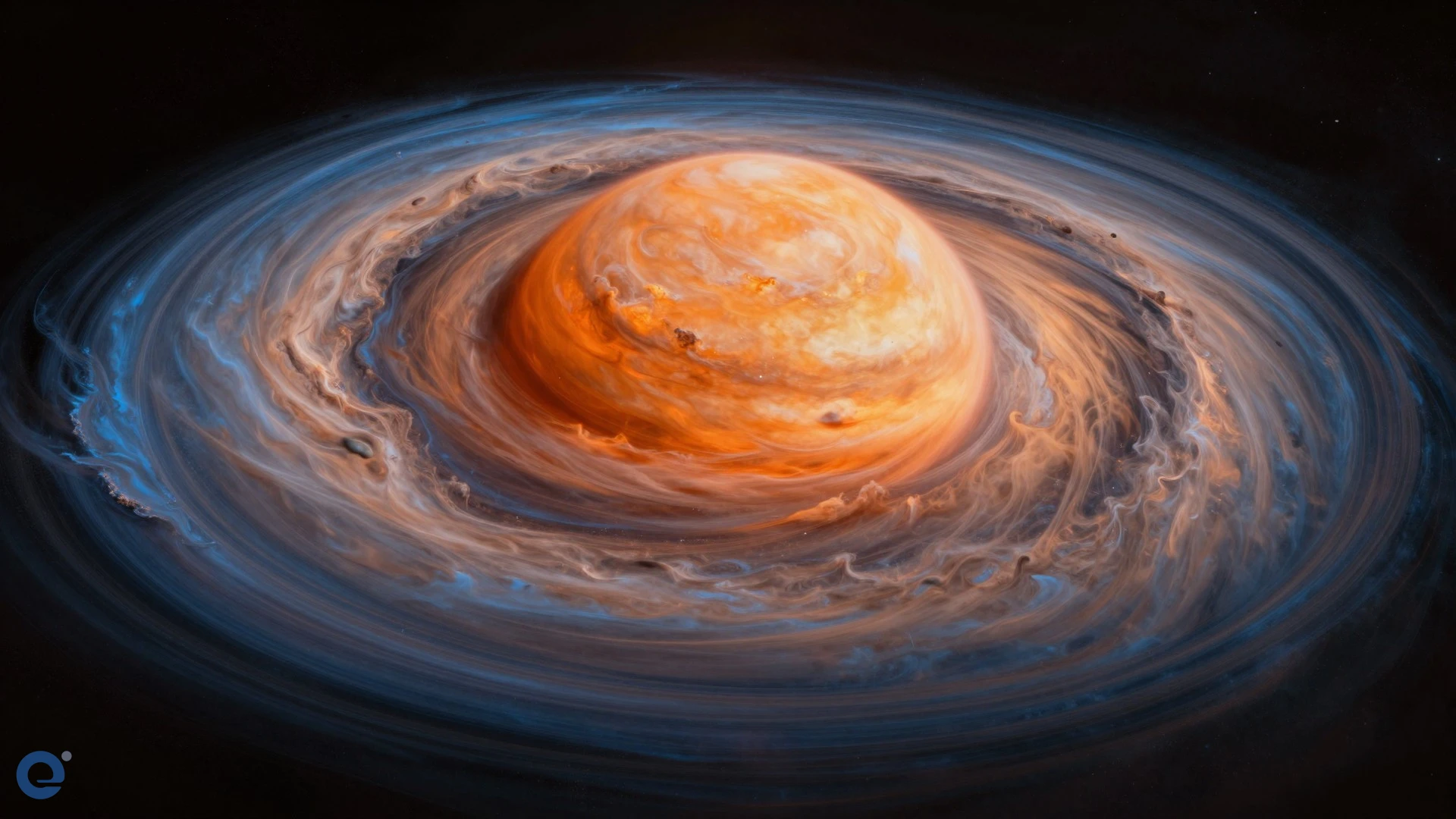
The tension between ideal assumptions and reality
Standard fluid models often rely on the assumption of local isothermality to simplify complex calculations. However, this approach frequently ignores the reality of radiation-hydrodynamics where gas, dust, and light interact in a non-linear fashion [4]. Researchers often face a choice between computational efficiency and physical accuracy.
Those who prioritize speed may overlook the subtle grain settling and trapping that define disk morphology. Conversely, those who insist on full self-consistency risk creating models that are computationally prohibitive. This trade-off is the central friction point in modern planetary science.
Myth versus reality in interstellar gas modeling
A common misconception is that the interstellar medium exists in a state of rest. In reality, the medium is in constant, supersonic motion driven by stellar winds and supernova explosions [2]. We must account for these shock waves to produce accurate simulations.
- Myth: Interstellar clouds collapse solely due to self-gravity.
- Reality: Magnetic pressure often exceeds thermal pressure, requiring magnetohydrodynamic waves to initiate density fragments.
- Myth: Navier-Stokes equations are sufficient for all space fluid problems.
- Reality: In regions of low ionization, ideal MHD equations fail, and we must include non-ideal effects to capture the physics accurately [2].
Navigating the complexities of accretion disks
Accretion disks are the engines of planetary growth. Understanding the transport of angular momentum within these disks remains a significant challenge for scientists [5]. Without precise modeling of these dynamics, we cannot explain the observed distribution of exoplanetary systems.
We must balance the astrophysical fluid dynamics with the observational data provided by modern telescopes. These instruments now offer unprecedented angular resolution, forcing us to refine our numerical schemes. A self-consistent approach that treats dust species as pressureless, diffusive fluids is now the gold standard for simulating thermodynamics in these environments.
A decision framework for simulation selection
Choosing the right simulation approach requires a clear evaluation of the physical regime. Planetary scientists should follow this decision-making process when selecting their modeling parameters:
- Assess the ionization degree: If low, abandon ideal MHD in favor of non-ideal treatments.
- Evaluate the cooling timescale: If the gas is not in thermal equilibrium, move beyond simple beta-cooling prescriptions.
- Determine dust-to-gas ratios: If dust is significant, treat species as separate, pressureless fluids to capture grain settling effects [4].
- Verify gravitational influence: Ensure the time-dependent gravitational field of spiral density waves is included for galactic-scale simulations.
The overlooked risk of simplified thermodynamics
Many researchers treat thermodynamics as an afterthought, using approximate prescriptions to save time. This is a dangerous oversight. By ignoring the complex interplay between gas and radiation, we risk missing the very features that define disk evolution [4].
The AI's impact on research integrity addressing hallucination and attribution errors in scientific information retrieval is a growing concern, but the error of oversimplification in physics remains a more immediate threat to scientific validity. We must demand higher standards for our numerical schemes, even when the computational cost is high. Accurate science cannot be rushed.
Future scenarios for planetary formation models
As we look toward the next decade, the integration of machine learning with traditional Navier-Stokes solvers will likely revolutionize the field. We may soon see real-time simulations that adjust their resolution based on the presence of shock waves or density fluctuations. This shift will allow us to explore parameter spaces that were previously unreachable.
However, we must remain vigilant. Automated models are only as good as the underlying physics they represent. Our The StarTalk discussion on AI and Navier Stokes a recap of the key insights from Neil deGrasse Tyson and Mordecai Mark Mac Low reminds us that the human element—the ability to interpret and critique the model—is irreplaceable. The future of planetary science lies in the marriage of rigorous fluid dynamics and advanced computational intelligence.
More Information
- Navier-Stokes equations: A set of partial differential equations that describe the motion of viscous fluid substances, essential for modeling gas dynamics in space environments.
- Astrophysical fluid dynamics: A branch of astronomy dealing with the motion of fluids in space, accounting for zero-gravity and vacuum conditions.
- Magnetohydrodynamics: The study of the magnetic properties and behavior of electrically conducting fluids, such as plasma in the interstellar medium.
- Radiation-hydrodynamics: A field of study that models the interaction between fluid dynamics and radiation, crucial for understanding the thermodynamics of protoplanetary disks.
- Accretion disks: Rotating disks of gas and dust that form around young stars, serving as the primary site for planet formation and angular momentum transport.


