
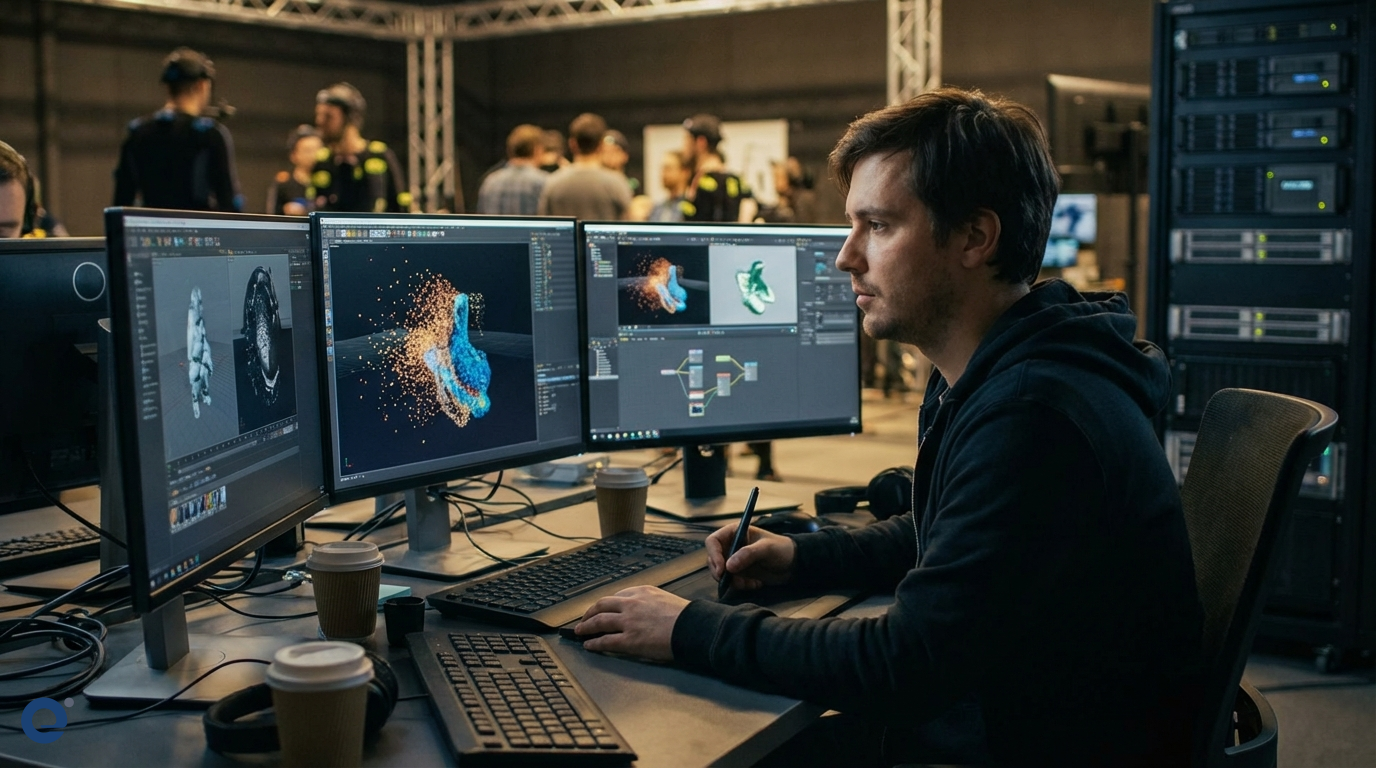
The world of visual effects (VFX) is constantly evolving. Furthermore, complex VFX visual effects are at the forefront of this change. They push the boundaries of what's possible on screen. For VFX Supervisors, managing these intricate projects is a significant challenge. However, it is also incredibly rewarding. This guide explores the depths of complex VFX, offering insights for supervisors navigating this demanding field.
Understanding the scope of complex VFX
What exactly makes a VFX shot "complex"? It often involves large-scale simulations like water or fire. Moreover, it can include highly detailed digital creatures or environments. Sometimes, the most complex effects are the invisible ones, seamlessly integrated into live-action footage. The VFX Supervisor's role is crucial in these projects. They oversee the entire process, from concept to final shot. Therefore, they need a deep understanding of both the artistic and technical aspects.
Key challenges in complex VFX production
Creating complex VFX is fraught with challenges. Firstly, the computational demands are immense. Simulating fluid dynamics, for example, requires solving complex mathematical equations like the Navier-Stokes equations[1] for millions of particles (Source 2). This leads to long simulation times.
Secondly, achieving the right scale and detail is difficult. A massive ocean simulation needs to look convincing both from afar and close up, showing large waves and fine spray (Source 2). Similarly, digital characters require intricate details in texture and movement.
Thirdly, the interaction between digital elements and real-world footage must be seamless. This involves precise tracking and integration. Consequently, artists spend much time ensuring realistic interactions, like a digital creature interacting with a live-action set.
Moreover, balancing physical accuracy with artistic direction is a constant struggle (Source 2). While simulations aim for realism, the director might need a specific look or behavior. Therefore, supervisors must guide their teams to meet these artistic goals while maintaining believability.
Rendering and lighting these complex scenes present their own hurdles. Realistic lighting of translucent materials like water or smoke is particularly challenging (Source 2). Additionally, managing the vast amounts of data and the intricate pipeline requires robust systems and clear communication.
Finally, budget and time constraints always loom large. Complex VFX is expensive and time-consuming. Supervisors must therefore manage resources effectively to deliver on time and within budget.
Technologies and techniques for complex VFX
Fortunately, numerous technologies and techniques help artists tackle these challenges. For fluid simulations, methods like FLIP (Fluid Implicit Particle)[3] and PIC (Particle-in-Cell) combine grid-based and particle-based approaches for better detail and stability (Source 2). Fluid simulation innovations are constantly being developed.
Machine learning is also making inroads. It can accelerate simulations by training neural networks on existing data to predict fluid behavior (Source 2). This can significantly reduce computation times. GPU acceleration is another key factor, with modern graphics cards speeding up simulations and rendering dramatically.
Adaptive resolution techniques allow simulations to have higher detail where needed, optimizing resource usage. In compositing[4], tools like Nuke and Adobe After Effects are essential for integrating various elements. After Effects, for instance, offers powerful tools for motion graphics and visual effects, including AI-powered features like the Roto Brush[2] for easier object separation (Source 1). After Effects features are widely used in the industry.
Advanced 3D modeling and animation software is crucial for creating digital assets. Techniques like motion capture provide realistic character movement. Photogrammetry and 3D scanning help create digital replicas of real-world objects and environments.
AI-powered tools within software like Adobe After Effects, such as the intelligent Roto Brush and Content-Aware Fill, streamline complex tasks like object removal and rotoscoping (Source 1). These tools help artists work more efficiently.
Case studies and examples
Consider a scene with a massive building collapsing. This requires detailed destruction simulations, dust, smoke, and debris, all interacting realistically. Or imagine a film featuring a talking animal; the complexity lies in creating believable facial animation and integrating it with the live-action performance, much like the challenges in Zootopia 2 with new characters.
Complex environmental effects, like storms or volcanic eruptions, also push VFX teams to their limits. Furthermore, invisible effects, such as digitally altering an actor's appearance or creating a period-accurate cityscape, require meticulous attention to detail to remain unnoticed.
The VFX supervisor's role in managing complexity
The VFX Supervisor is central to managing complexity. It starts with thorough pre-production planning and previs (previsualization). This helps identify potential challenges early on. On-set supervision is also vital to ensure that live-action footage is shot correctly for VFX integration.
Supervisors manage the VFX team, guiding artists and technical directors. They establish and oversee the pipeline, ensuring a smooth workflow. Clear communication with the director and other departments is paramount to keep everyone aligned.
Quality control is a continuous process. Supervisors review shots, provide feedback, and troubleshoot problems. They need a keen eye for detail and strong problem-solving skills. They also need to be aware of the VFX service costs and how they relate to the project's budget.
Future trends in complex VFX
The future of complex VFX looks exciting. Real-time VFX, powered by game engines like Unreal Engine, is becoming more prevalent, allowing for faster iterations and on-set visualization. Creating environments with Unreal Engine is a growing field.
AI and machine learning will continue to automate and enhance various processes. Cloud-based rendering and collaboration platforms will offer greater flexibility and computing power. Virtual production techniques, using LED walls and real-time rendering, are also transforming how films are made, blending live-action and CGI[5] more seamlessly than ever before.
In conclusion, complex VFX visual effects represent a pinnacle of filmmaking artistry and technology. For VFX Supervisors, it's a field that demands continuous learning, strong leadership, and a passion for pushing creative and technical boundaries.
More Information
- Navier-Stokes equations: These are a set of partial differential equations that describe the motion of viscous fluid substances. They are fundamental in fluid dynamics and are computationally intensive to solve for VFX simulations.
- Roto Brush: An AI-powered tool in Adobe After Effects that helps automate the process of rotoscoping, which is separating a subject from its background in a video sequence, even with complex edges.
- FLIP solvers: Fluid Implicit Particle solvers are a hybrid technique for simulating fluids. They use particles to track fluid and a grid to enforce incompressibility, offering good detail and stability for splashes and spray.
- Compositing: The process of combining multiple layers of images or video (from live-action, CGI, matte paintings, etc.) to create a final, seamless image or sequence in visual effects.
- CGI (Computer-Generated Imagery): The application of computer graphics to create or contribute to images in art, printed media, video games, simulators, computer animation, and VFX in films, television programs, shorts, commercials, and videos.