
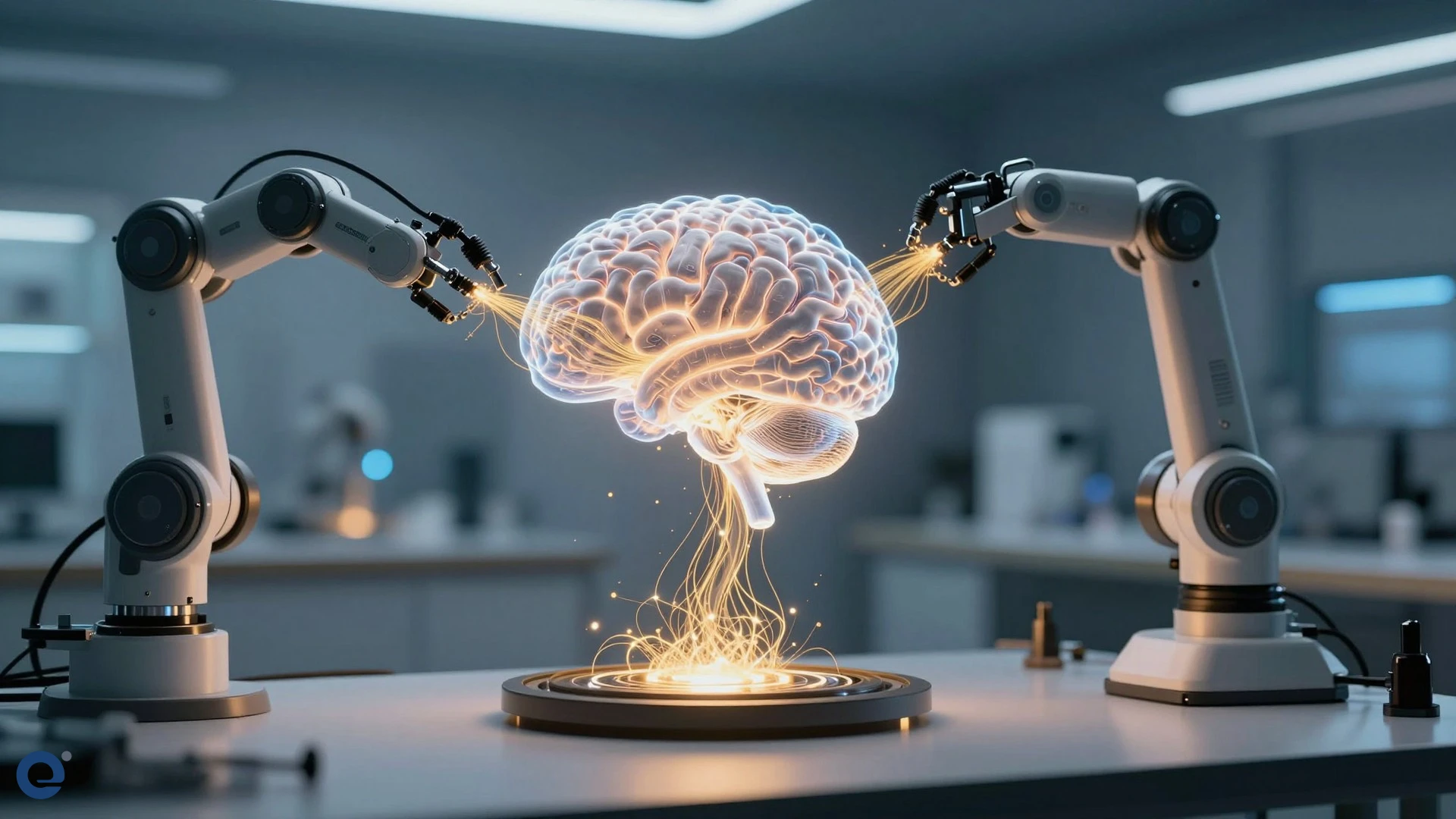
The transition of artificial intelligence from a passive creative tool to an active participant in content generation has shattered traditional legal definitions of authorship. While many assume that prompt-based generation confers ownership, recent legislative shifts suggest a more restrictive reality where human intent must be explicitly documented to secure intellectual property rights [1].
This evolving landscape forces creators and legal professionals to navigate a "salami-slicing" approach to copyright, where only human-driven segments of a work receive protection [3]. To maintain a competitive edge, firms like EON Tech must now rigorously audit the creative process to distinguish between algorithmic automation and genuine intellectual judgment.

The shift from tool to participant
The fundamental tension in modern intellectual property law lies in the definition of "authorship." Historically, the law required a human hand to guide the creative process [5]. Today, emerging regulatory frameworks across multiple jurisdictions are codifying the requirement that AI remains a tool, not a creator.
This creates a binary legal environment. If a machine generates content without significant human intervention, that work falls into the public domain [1]. Consequently, the mere act of prompting an AI is increasingly viewed as an administrative task rather than an act of creation.
A framework for documenting creative contribution
Legal professionals must now advise clients to adopt a "process-oriented" documentation strategy. Because courts are moving toward granular assessments, creators must prove their role in the final output [3]. This is not merely an ethical preference but a strict legal necessity for asset protection.
Consider the following decision framework for establishing authorship:
- The prompt phase: Does the initial input demonstrate unique intellectual judgment or merely generic instruction?
- The iterative phase: How much manual refinement occurs after the initial AI generation?
- The final assembly: Is the human the primary architect who makes the decisive choices about the final composition?
Ethics beyond the letter of the law
Ethics is often confused with legal compliance, yet the two are distinct domains [4]. While the law mandates what is required, moral philosophy asks what we ought to do [2]. Relying solely on current regulations to govern AI use creates a blind spot regarding the intrinsic value of human labor.
If society accepts that AI can "clone" the style of human creators without attribution, we risk a systemic devaluation of creative work. A deontological approach suggests that we have a duty to respect the source of our training data, regardless of whether the law currently mandates such transparency [2]. Overlooking this duty may lead to a future where innovation is stifled by a lack of incentive for human creators.
The risk of procedural negligence
The greatest risk to modern firms is the assumption that AI-assisted workflows are inherently protected. Without a clear audit trail, organizations may find their most valuable assets are legally unenforceable. This is a technical failure as much as a legal one Technical post-mortem: why software systems fail and how to build resilience. Legal teams must treat AI output as a draft that requires human validation to reach the threshold of protected intellectual property [3].
Proactive organizations are already implementing internal "creative logs" to track the evolution of AI-assisted projects. This ensures that when a challenge to ownership arises, the firm can demonstrate the specific, decisive human contributions that warrant copyright protection [5]. Failure to do so leaves the firm vulnerable to competitors who can legally replicate "unprotected" AI output.
More Information
- Human-centric principle: A legal doctrine asserting that only natural persons can be recognized as authors, explicitly rejecting the notion that AI systems can hold independent legal status or copyright.
- Normative ethics: A branch of moral philosophy that investigates principles governing how people should act, focusing on duties, obligations, and the nature of right and wrong behavior.
- Creative threshold: The minimum level of human intellectual judgment and selection required for a work to qualify for copyright protection under modern AI-influenced legal standards.
- Applied ethics: The practical application of moral considerations to real-life situations, such as business practices, technology deployment, and the ethical use of AI in creative industries.
- Significant contribution: A legal standard requiring that a human must exercise substantial control and decision-making during the creation process to be considered an inventor or author.


