

Engineers often treat turbulence as a nuisance, a chaotic variable to be smoothed away or ignored in simplified models. Yet, the same physics that allow a dimpled sphere to slice through the air define the evolution of galaxies and the efficiency of industrial heat exchangers. The core thesis of this analysis is that turbulence is not merely an obstacle to laminar flow but a fundamental, manageable mechanism for energy transport that, when engineered correctly, shifts the boundaries of aerodynamic performance.
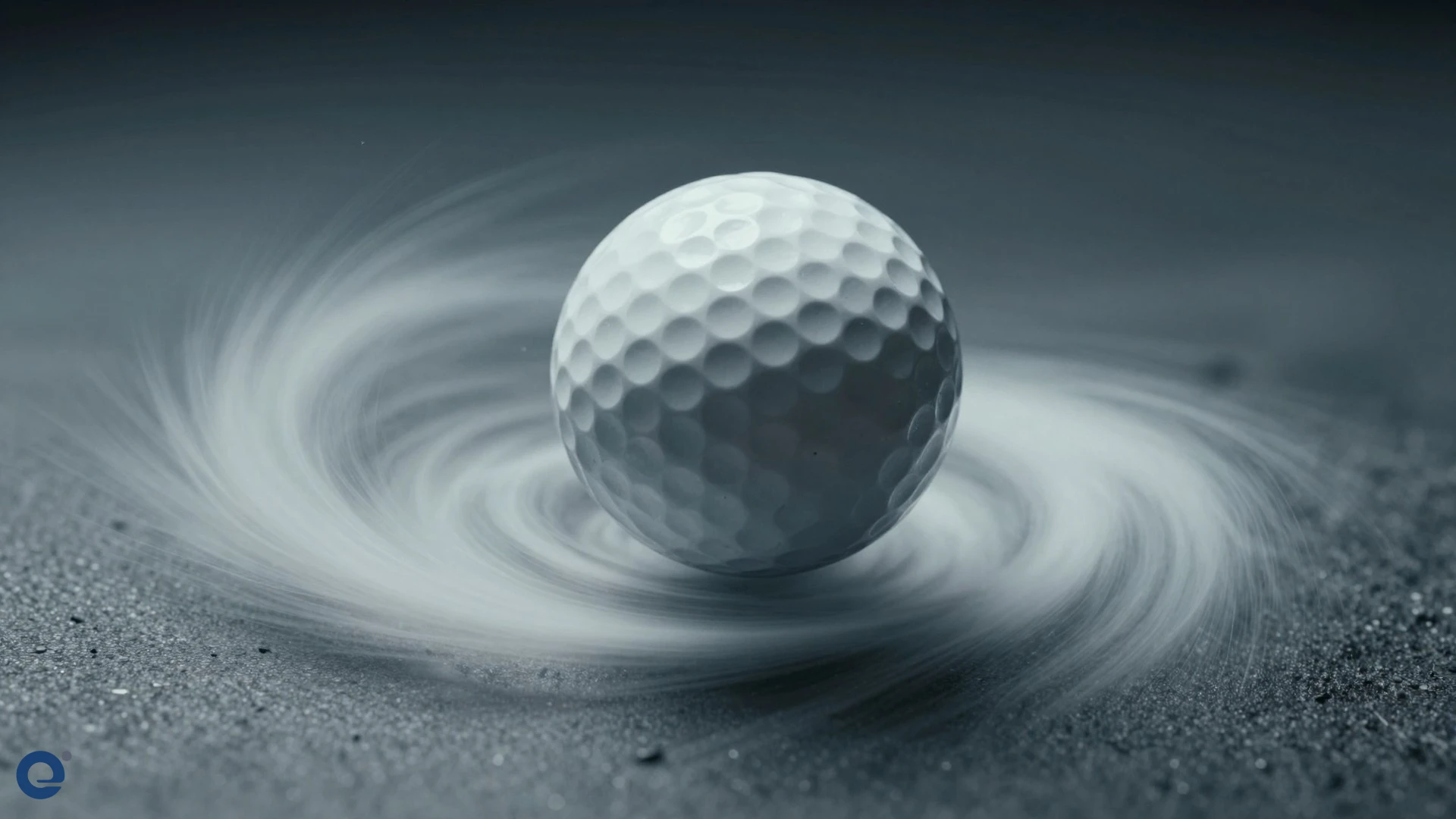
Consider the humble golf ball. Conventional wisdom once suggested that a perfectly smooth surface would minimize resistance. However, empirical testing reveals that a smooth sphere experiences massive flow separation and a high-pressure wake, significantly shortening its flight distance [1]. By introducing dimples, we force a transition to a turbulent boundary layer, which remains attached to the surface longer, drastically reducing drag. This is the paradox of chaotic motion: controlled turbulence is often the most efficient path to stability.
The engineering paradox of flow separation
Aerospace engineers frequently encounter the same physical phenomena that dictate the trajectory of a spinning golf ball. When fluid flows over a curved surface, it eventually loses momentum and detaches, creating a low-pressure wake that pulls the object backward [2]. This drag force is the primary enemy of fuel efficiency in both aviation and automotive design.
The physics of dimpled surfaces teaches us that we can delay this separation by energizing the boundary layer. By inducing small-scale turbulence, we mix high-velocity fluid from the outer flow into the slower region near the wall. This effectively "re-energizes" the flow, allowing it to withstand the adverse pressure gradient for a longer duration.
This principle is not limited to sports equipment. It is a cornerstone of wing design, where vortex generators are used to prevent stall at high angles of attack. EON Tech engineers have recently applied similar boundary layer control strategies to optimize intake manifolds, ensuring that fluid remains attached even under extreme pressure fluctuations.
From local vortices to galactic gas dynamics
While an engineer focuses on the Reynolds number of a component, astrophysicists observe turbulence on a scale that defies human intuition. In the interstellar medium, gas dynamics are governed by the same Navier-Stokes equations that describe the air around a golf ball [3]. The difference lies in the scale and the presence of magnetic fields.
In galactic gas dynamics, turbulence is the engine of star formation. Chaotic motion within giant molecular clouds creates localized regions of high density, which eventually collapse under gravity. Here, turbulence acts as both a catalyst and a regulator. It prevents runaway collapse while simultaneously driving the mixing of heavy elements throughout the galaxy.
Understanding these flows requires a shift in perspective. We must move away from the assumption that fluid motion is a linear, predictable path. Instead, we must view it as a cascade of energy, moving from large, energetic vortices down to the molecular scale where viscosity finally dissipates the motion into heat [4].
A decision framework for managing chaotic flows
When designing systems that involve fluid interaction, engineers should follow a structured approach to determine whether to suppress or exploit turbulence. The following framework helps in selecting the appropriate strategy for complex fluid systems:
- Identify the critical Reynolds number: Determine the threshold where the flow transitions from laminar to turbulent for your specific geometry [5].
- Assess the cost of drag: If the system is drag-limited, investigate surface modifications that promote controlled turbulence to delay separation.
- Evaluate heat transfer requirements: If the goal is cooling, turbulence is your ally. Enhanced mixing increases the convective heat transfer coefficient, making turbulent flow preferable.
- Simulate with high-order schemes: Use high-order computational fluid dynamics to capture the fine-scale structures that standard models often smooth out.
The overlooked risk of over-simplification
A common mistake in modern engineering is the over-reliance on Reynolds-Averaged Navier-Stokes (RANS) models. While computationally efficient, RANS models often fail to predict separation in highly curved or rotating flows. This is a significant oversight when designing high-performance components.
By relying on averaged data, engineers may miss the transient, chaotic bursts that actually cause structural fatigue. The million dollar question: Navier-Stokes smoothness hypothesis and the quest for global solutions or infinite blow-ups in fluid velocity fields remains a reminder that our mathematical grasp of turbulence is still incomplete. We must acknowledge that our models are approximations, not absolute truths.
Strategic implications for future aerospace design
The future of aerospace engineering lies in active flow control. Rather than relying on static dimples or fixed vortex generators, we are moving toward surfaces that can sense flow conditions and adjust their geometry in real-time. This is the next frontier of chaotic fluid management.
By integrating sensors with micro-actuators, we can manipulate the boundary layer on demand. This allows an aircraft to maintain optimal lift-to-drag ratios across a wide range of flight envelopes. It transforms the vehicle from a passive object into an active participant in its own fluid environment.
Furthermore, the ability to Navier Stokes equations the physics of fluid flow from cosmic plasma to ocean currents exploring the continuum assumption and its limits provides the theoretical foundation for these advancements. As we refine our ability to predict and control turbulence, we unlock new levels of efficiency that were previously thought to be physically impossible.
Conclusion
Turbulence is not a failure of design; it is a fundamental property of the universe that demands respect and mastery. Whether we are optimizing the flight of a golf ball or modeling the birth of stars, the core challenge remains the same: understanding the transition from order to chaos. By embracing the complexity of fluid motion rather than fighting it, engineers can create systems that are not only more efficient but also more resilient to the unpredictable nature of the physical world.
More Information
- Reynolds number: A dimensionless quantity used in fluid mechanics to predict flow patterns by measuring the ratio of inertial forces to viscous forces within a fluid.
- Flow separation: The phenomenon where the boundary layer of a fluid detaches from the surface of a solid body, creating a wake that increases pressure drag.
- Navier-Stokes equations: A set of partial differential equations that describe the motion of viscous fluid substances, serving as the foundation for modern fluid dynamics.
- Boundary layer: The thin layer of fluid in the immediate vicinity of a bounding surface where the effects of viscosity are significant.
- Turbulators: Surface irregularities, such as dimples or ridges, designed to trigger turbulence in the boundary layer to prevent flow separation and reduce drag.


