
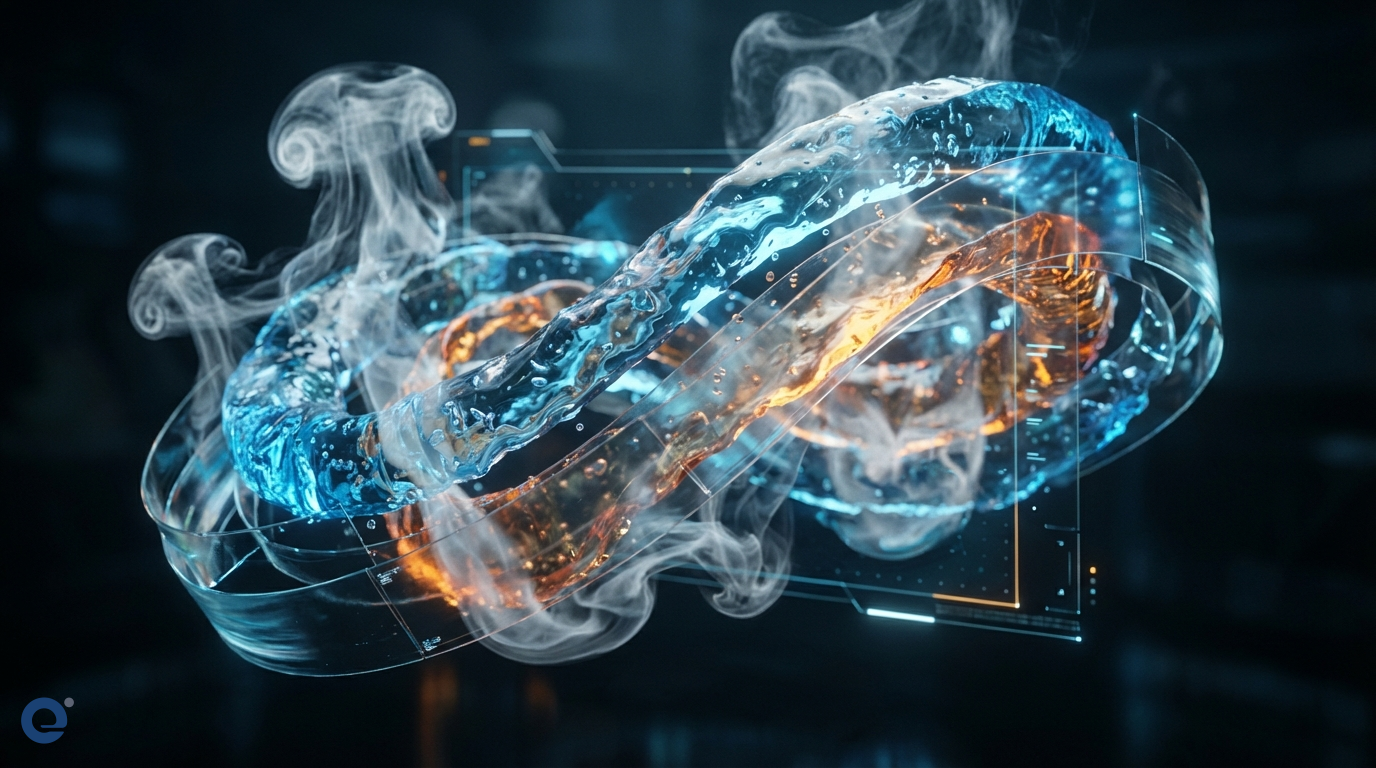
Electrostatic forces can dramatically influence the behavior of liquids and smoke. For simulation artists, understanding these effects opens up a world of realistic and fantastical visual possibilities. This article explores the science and its application in visual simulations.
The invisible force: What are electrostatic effects?
Electrostatics is a branch of physics. It studies electric charges at rest. Consequently, it examines the forces between them. These forces, called electrostatic forces, can attract or repel objects.
When materials gain or lose electrons, they become electrically charged. Therefore, an imbalance of electrons creates a net charge. Like charges repel each other. Conversely, opposite charges attract.
Coulomb's Law and electric fields
The fundamental force between two stationary charged particles is described by Coulomb's Law[4]. This law states the force is proportional to the product of the charges. It is also inversely proportional to the square of the distance between them. A charged object creates an electric field around itself. This field exerts a force on other charges within it.
Simulation artists can visualize these fields. Lines of force can represent their direction and strength. This helps in understanding particle movement.
How electrostatics interacts with smoke and aerosols
Smoke and aerosols consist of tiny particles suspended in a gas, usually air. These particles can become electrically charged. Subsequently, their movement can be controlled by electric fields.
Natural processes can charge particles. For instance, friction or ultraviolet radiation can cause charging. However, artificial charging is often used in industrial applications.
Charging the particles
One common method to charge particles is through a Corona Discharge[2]. This occurs when a high voltage is applied to a sharp electrode. The strong electric field near the electrode ionizes the surrounding air. These ions then collide with and attach to the smoke or aerosol particles, giving them a net charge (Particle Charging[3]).
Once charged, these particles will move under the influence of an external electric field. This is the principle behind many air cleaning technologies.
Electrostatics and liquids
Liquids can also be influenced by electrostatic forces. This is especially true for Dielectric Liquids[5], which are poor conductors of electricity. When a dielectric liquid is subjected to a strong electric field, it can become polarized or even atomized into fine droplets.
Electrostatic atomization is used in various applications. For example, inkjet printing and electrostatic painting rely on this principle. The liquid is charged and then breaks up into small, charged droplets due to electrostatic repulsion. These droplets can then be directed by an electric field.
Electrohydrodynamics (EHD)
The study of the dynamics of electrically charged fluids is called electrohydrodynamics (EHD). It involves the interplay of fluid mechanics and electrostatics. EHD effects can create fascinating liquid behaviors. These include jets, sprays, and unique surface deformations.
Simulating EHD requires coupling fluid solvers with electrostatics solvers. This can be complex but yields very interesting results.
Applications influencing visual simulation
Several real-world applications use these principles. Understanding them can inspire simulation artists.
Electrostatic precipitators
Electrostatic Precipitators[1] (ESPs) are devices that remove fine particles, like dust and smoke, from flowing gas. They use electrostatic forces to charge the particles and then collect them on electrodes. Simulating the wispy collection of smoke in an ESP can be a visual challenge.
Artists might simulate ESPs in industrial scenes. The visual effect involves smoke being drawn towards collection plates.
Electrostatic painting
In electrostatic painting, paint droplets are charged. The object to be painted is grounded or oppositely charged. This attracts the paint droplets, leading to an even coat and less overspray. Simulating this "wrap-around" effect is a good project.
Inkjet printing
Some inkjet printers use electrostatic forces to direct tiny ink droplets onto paper. The precision involved is remarkable. Simulating this controlled droplet formation and placement can be very detailed work.
Simulating electrostatic effects on smoke
To simulate smoke influenced by electric fields, artists need to consider several factors. The smoke particles need to be treated as individual entities or a density field. They also need to interact with a simulated electric field.
Particle systems approach
A particle system is often the most intuitive way. Each particle represents a small portion of smoke. You would:
- Emit particles as usual.
- Assign a charge to each particle (or a mechanism for them to acquire charge, like passing through a charge zone).
- Define an electric field in the scene (e.g., from virtual electrodes).
- Apply a force to each charged particle based on the field strength and direction at its location (F = qE).
- Combine this with other forces like air resistance and turbulence.
This allows for detailed and dynamic smoke behavior.
Volume-based approach
Alternatively, smoke can be represented as a density volume. The electric field would then influence the advection of this density. This is more complex to set up accurately. However, it can be efficient for large-scale smoke.
Simulating electrostatic effects on liquids
Simulating liquids under electrostatic influence often involves surface tension and fluid dynamics. Techniques like Smoothed Particle Hydrodynamics (SPH) or Voxel Fluid Grids can be used.

For electrostatic atomization, you need to model:
- The liquid surface acquiring charge.
- The repulsive forces between surface charges overcoming surface tension.
- The formation of Taylor cones and the emission of fine jets or droplets.
- The trajectory of charged droplets in an electric field.
This requires a robust fluid solver with added electrostatic force calculations.
Software and tools
Software like Houdini is well-suited for these simulations. It offers particle systems, fluid solvers (FLIP, SPH), and tools to define custom forces and fields (VEX, VOPs). Blender, with its Mantaflow fluids and particle systems, can also be used, though custom field interactions might require scripting or add-ons. For those interested in the underlying physics, understanding lighting in 3D animation can also help represent the visual qualities of these phenomena.
Artists can also use custom shaders to visualize electric fields or the charge on particles and liquids. This adds another layer of visual information.
Challenges in simulation
Simulating these effects accurately can be computationally expensive. The number of particles or fluid elements can be very large. Moreover, the forces change rapidly, requiring small time steps.
Another challenge is getting the physical parameters right. Charge levels, field strengths, and fluid properties all interact. It often requires experimentation to achieve the desired look.
Artistic applications
Beyond realism, these effects can be used for fantastical visuals. Imagine smoke tendrils dancing to invisible fields, or liquids forming impossible shapes. The controlled nature of electrostatic forces allows for very deliberate artistic direction.
Consider magical effects, sci-fi technology, or abstract art. The underlying physics provides a basis for believable yet extraordinary visuals. For instance, mastering complex VFX often involves understanding and manipulating such physical forces in a simulated environment.
Conclusion
Electrostatic effects on liquids and smoke offer a rich area for simulation artists. By understanding the basic principles, artists can create more realistic and imaginative visuals. The interplay of invisible forces and visible matter provides endless creative opportunities.
More Information
- Electrostatic Precipitator: A device that removes suspended dust or smoke particles from a gas or air stream by applying a high-voltage electrostatic charge and collecting the particles on charged plates.
- Corona Discharge: An electrical discharge brought on by the ionization of a fluid, such as air, surrounding a conductor that is electrically energized, occurring when the electric field strength exceeds a certain value but is not high enough for arcing.
- Particle Charging: The process by which neutral particles (like those in smoke or aerosols) acquire an electric charge, often through collision with ions generated in a corona discharge or by other mechanisms.
- Coulomb's Law: A law of physics describing the electrostatic interaction between electrically charged particles. It states that the force is proportional to the product of the charges and inversely proportional to the square of the distance between them.
- Dielectric Liquid: An electrically insulating liquid that can be polarized by an applied electric field. These liquids are poor conductors of electricity but can store electrical energy when subjected to an electric field.