

In today's competitive landscape, understanding customer emotions is paramount. Customer Experience (CX) Strategy Directors constantly seek deeper insights. Natural Language Processing (NLP)[1] sentiment analysis offers a powerful solution. It moves beyond simple data points. Instead, it deciphers the true feelings behind customer interactions. This article explores the advanced logic driving effective sentiment analysis. It highlights its strategic value for enhancing customer journeys.
The strategic imperative of understanding customer sentiment
Customer sentiment analysis, also known as opinion mining, is crucial. It automatically identifies and measures how customers feel. This applies to your products, brand, or services[3]. Modern support teams gather vast amounts of customer data. This includes chats, calls, and emails. These interactions contain the invaluable voice of the customer. Unlocking this information provides deep insights into customer preferences. It helps businesses understand public opinion and customer satisfaction. Therefore, it is a powerful way to keep a pulse on customers.
Over 60% of customers now have higher service standards. This makes leveraging customer sentiment analysis more critical than ever. It helps quantify emotions expressed in text data. This enables businesses to gain insights into overall sentiment trends. Ultimately, it drives better decision-making. Customer sentiment analysis improves the customer experience in tangible ways.
Traditional sentiment analysis: Strengths and limitations
Sentiment analysis typically categorizes text as positive, negative, or neutral[2]. It relies on NLP, text analysis, and computational linguistics. Key aspects include text processing and sentiment classification. Feature extraction identifies linguistic cues. Machine learning algorithms then predict sentiment. These methods are effective for broad categorization. They provide a foundational understanding of customer feedback.
However, human emotions are complex. Traditional methods often struggle with nuance. They may miss sarcasm, irony, or subtle dissatisfaction. A simple "positive" or "negative" label can oversimplify feedback. This can lead to misinterpretations. For CX directors, this means potentially missing critical signals. It can hinder truly empathetic responses. Therefore, a more sophisticated approach is often needed.
Embracing nuance with fuzzy logic in sentiment analysis
To address these limitations, advanced logic is emerging. Fuzzy logic[4] offers a powerful alternative. It extends classical logic. It handles "partial truth" rather than just true or false. This is ideal for the vagueness inherent in human language. Fuzzy logic allows assigning degrees of positivity or negativity. This reflects the subtleties of human emotions more effectively. It moves beyond rigid classifications. Fuzzy logic for sentiment analysis can manage ambiguity. Words often have different connotations based on context.
This approach uses linguistic variables. Examples include "good," "bad," or "average." These are more interpretable than numerical values alone. Fuzzy logic also employs a rule-based system. This allows incorporating expert knowledge. Heuristic rules guide the analysis process. This makes the system more adaptable. It can better capture the complexities of customer feedback.
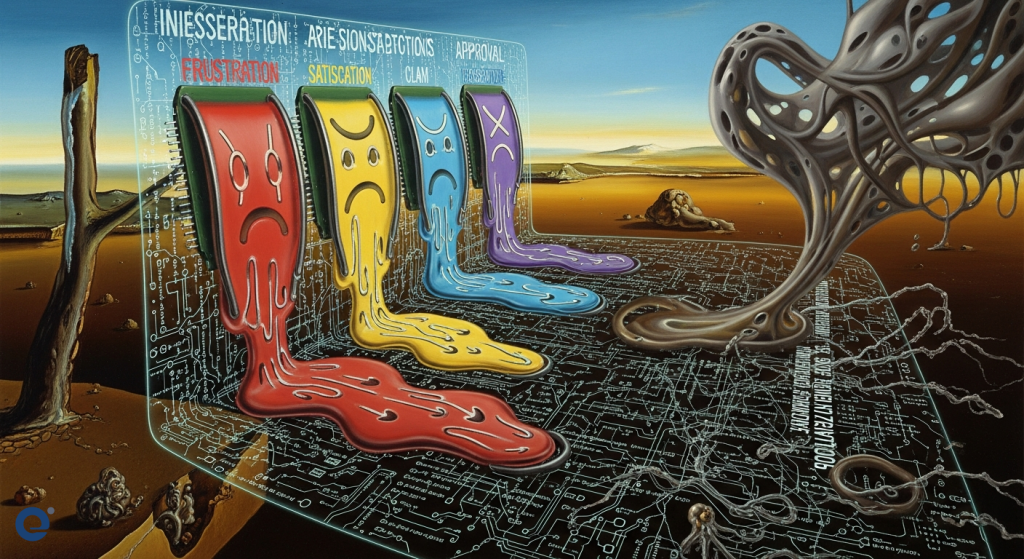
Components of a fuzzy logic sentiment system
A fuzzy logic system for sentiment analysis has several key components. First is fuzzification[5]. This converts input text into fuzzy sets. Words are mapped to degrees of sentiment. For instance, "happy" might be 0.8 positive and 0.1 negative. Next, fuzzy rules define relationships. These are "if-then" statements. For example, "IF the word is 'happy' THEN the sentiment is positive."
An inference engine applies these rules. It processes the fuzzified inputs. This generates fuzzy outputs. Finally, defuzzification converts the fuzzy output. It produces a crisp value, such as a sentiment score. This score can range from -1 (very negative) to +1 (very positive). This detailed scoring provides a richer understanding. It helps CX directors pinpoint specific emotional states. This enables more targeted interventions.
Strategic applications for CX directors
Implementing fuzzy logic sentiment analysis offers significant advantages. It allows for emotionally intelligent virtual assistants. These can understand and respond aptly to human emotion. This bridges the emotional divide in human-computer interactions. Such systems have broad applications. They can enhance support lines and teletherapy solutions. By understanding nuanced sentiment, AI can bond with people not just through words, but through emotions.
For CX directors, this means proactive issue resolution. You can identify escalating frustration before it boils over. It also enables personalized customer interactions. Responses can mirror or contradict detected sentiment. This creates a more human-like experience. Furthermore, it provides granular insights for product development. Understanding specific emotional triggers helps refine offerings. This leads to higher customer satisfaction and loyalty. Sentiment analysis helps businesses gain insights into customer satisfaction.
This advanced logic also supports better agent training. It highlights common emotional patterns in customer interactions. Agents can then learn to address these more effectively. It also helps in managing brand reputation. Early detection of negative sentiment allows for swift action. This mitigates potential crises. Ultimately, it transforms raw data into actionable intelligence. This empowers CX leaders to make informed strategic decisions. It drives continuous improvement across the customer journey.
Challenges and the future outlook
While powerful, implementing fuzzy logic sentiment analysis has challenges. It requires careful definition of fuzzy rules. This often involves expert knowledge. Data quality and context are also critical. The system must be trained on relevant datasets. However, the benefits far outweigh these complexities. The ability to capture subtle emotional cues is invaluable.
The future of NLP sentiment analysis logic is bright. We will see continued advancements in AI and machine learning. This will further refine sentiment detection. Integration with voice sentiment analysis will become more seamless. This will create truly holistic emotional understanding. CX directors who embrace these advanced methodologies will lead their organizations. They will deliver unparalleled customer experiences. This ensures a competitive edge in the digital age.
More Information
- Natural Language Processing (NLP): A branch of artificial intelligence that enables computers to understand, interpret, and generate human language. It allows machines to process text and speech data.
- Sentiment Analysis: The process of determining the emotional tone behind a body of text. It typically categorizes text as positive, negative, or neutral, also known as opinion mining.
- Customer Sentiment Analysis: The automated process of discovering and measuring how customers feel about a product, brand, or service. It extracts insights from customer interactions.
- Fuzzy Logic: A form of many-valued logic that deals with reasoning that is approximate rather than fixed and exact. It allows for partial truth values between "completely true" and "completely false."
- Fuzzification: The process of converting crisp (numerical) input data into fuzzy sets. In sentiment analysis, this maps words or phrases to degrees of sentiment.