
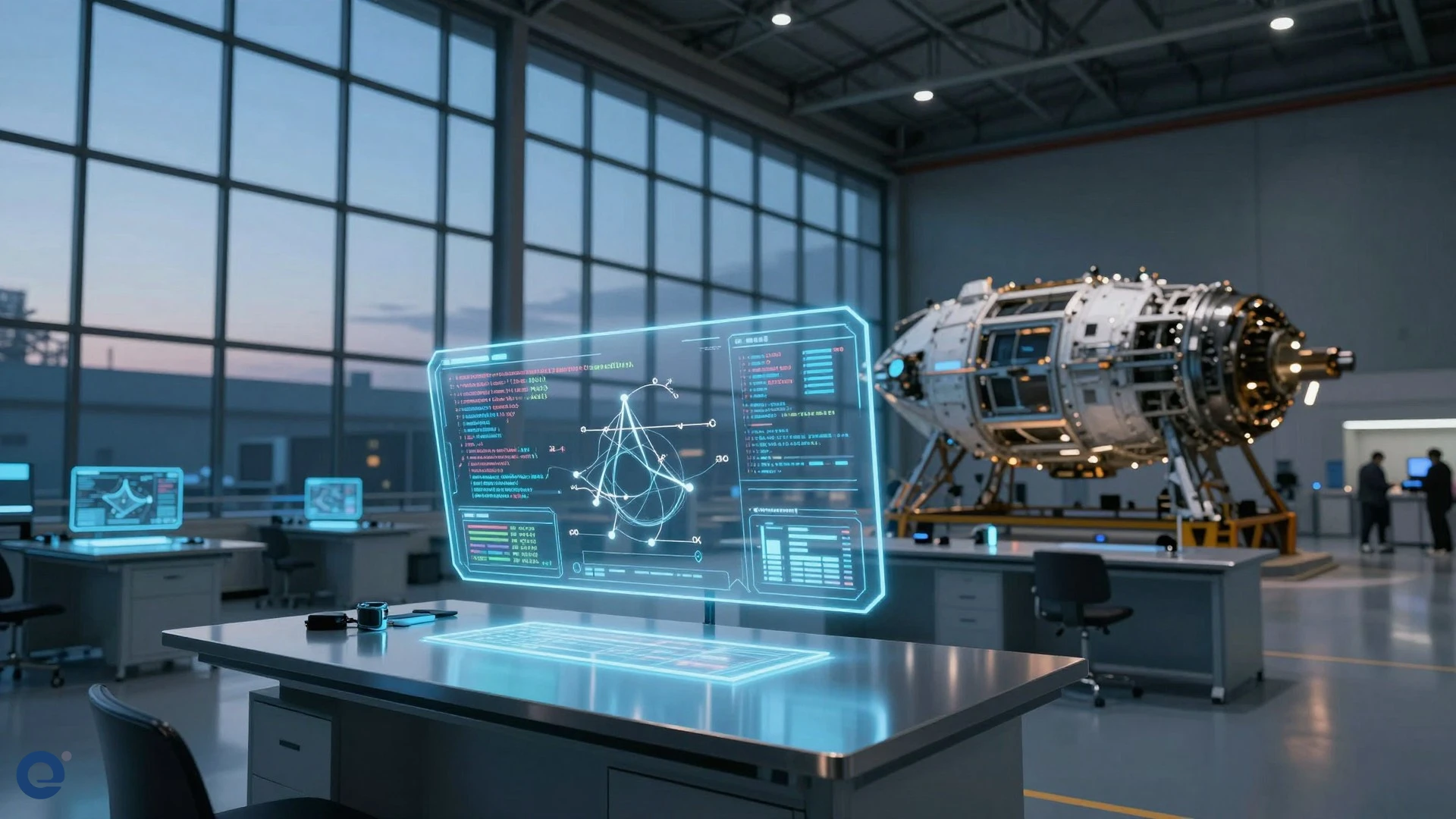
Aerospace engineering demands absolute predictability. Every line of code in a flight control system must undergo rigorous verification. However, the recent integration of generative AI introduces a dangerous variable: non-deterministic output. By relying on probabilistic text generation for critical decision-making, engineers risk introducing silent failures that standard testing cannot catch.
The core thesis is simple: mission-critical aerospace systems must transition from generative, conversational AI to machine-native, typesafe decision engines. This shift ensures that every AI-driven action adheres to strict data contracts, preventing the "hallucination" of commands that could jeopardize flight safety. While traditional LLMs excel at creative tasks, they lack the structural discipline required for real-time avionics [2].

How does the reliance on generative models threaten flight safety?
Current AI development often prioritizes human-like interaction over machine-native reliability. When an aerospace engineer uses a standard LLM to interpret sensor data, the model produces a natural language string. This string requires parsing, which introduces latency and potential error points [3]. In a high-stakes environment, this typesafe AI approach is far superior to fuzzy prompt engineering.
Generative models are designed to predict the next token, not to enforce logic. This creates a fundamental mismatch with the structured systems that govern aerospace software [1]. If a system expects a boolean "true" or "false" but receives a conversational paragraph, the resulting runtime error can be catastrophic. EON Tech has observed that even minor deviations in output format can cascade into significant system instability.
Why are machine-native decision models the new standard for reliability?
Machine-native intelligence treats decisions as reflex classifications rather than long-form prose. By using primitives like Choice, Score, and Noul, these models return data that software can execute immediately [5]. This eliminates the need for brittle regex parsing or complex Pydantic hacks. It allows engineers to build mastering agentic AI: a technical guide to modern orchestration directly into the flight stack.
Consider the difference in performance and safety:
- Generative LLMs: High latency, unpredictable output, requires constant human-in-the-loop oversight.
- Typesafe AI: Sub-100ms latency, deterministic JSON outputs, calibrated confidence scores for every decision [2].
Which decision framework should engineers apply to AI integration?
To evaluate whether an AI component is ready for flight-critical deployment, engineers should utilize a specific scorecard. This framework moves beyond simple performance metrics to focus on structural safety and predictability.
- Type enforcement: Does the model output strictly typed data (e.g., enum or struct) that the compiler can validate?
- Deterministic latency: Is the response time consistent enough for real-time control loops [3]?
- Confidence calibration: Does the model provide a mathematical probability for its decision, allowing the system to escalate to human operators when uncertainty is high [5]?
- Zero-hallucination constraint: Can the model be restricted to a finite set of valid actions, preventing it from generating invalid commands?
How can engineers mitigate the risks of AI-driven automation?
The primary risk is overconfidence in the model's reasoning capabilities. Aerospace engineers must treat AI as a specialized component rather than a general-purpose oracle. By implementing a "speculative fan-out" architecture, systems can evaluate multiple decision branches simultaneously [5]. This ensures that the system always selects the safest path based on verified data inputs.
Furthermore, the Jevons Paradox suggests that as AI becomes cheaper and faster, we will embed it everywhere [5]. This makes the transition to typesafe systems even more urgent. If we continue to use non-deterministic models, the sheer volume of AI-driven decisions will inevitably lead to systemic failure. We must adopt technical post-mortem: why software systems fail and how to build resilience to understand these risks fully.
What is the future of deterministic AI in aerospace?
The future lies in models that function more like compiled code than conversational chatbots. By grounding AI decisions in rigid data types, we can safely expand the role of automation in flight systems. This does not mean removing human oversight; it means empowering humans to manage systems that are inherently more predictable and easier to audit [2].
Aerospace engineers must demand that AI providers move away from the "chat" paradigm. We need tools that respect the discipline of software engineering. When we treat AI as a reliable, typed component, we unlock the potential for truly autonomous and safe aerospace operations [3].
More Information
- Language [1]: A structured system of communication consisting of grammar and vocabulary, serving as the primary means for humans to convey meaning through spoken, signed, or written forms.
- Typesafe AI [2]: A class of machine-native models that output structured, typed data rather than conversational text, designed to integrate seamlessly into software pipelines with high reliability.
- System 1 Models [3]: AI architectures modeled after rapid, reflex-based cognitive processes, optimized for low-latency decision-making in automated software environments rather than creative generation.
- Jevons Paradox [4]: An observation that as technological progress increases the efficiency of a resource, the total consumption of that resource often increases rather than decreases.
- Calibrated Confidence [5]: A mechanism where an AI model provides an estimate of its certainty alongside its decision, allowing software to handle uncertainty through pre-defined escalation thresholds.


