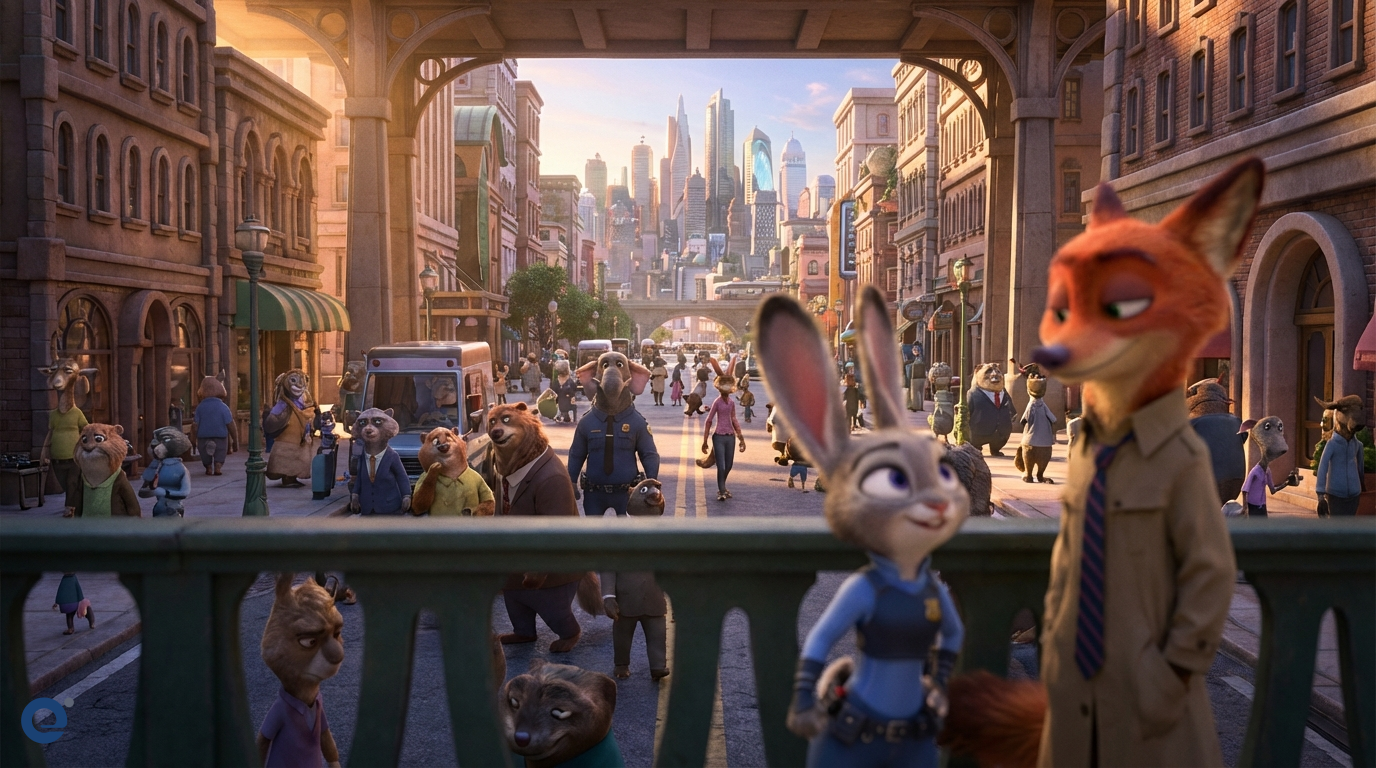
Disney’s 2016 film “Zootopia” (also known as “Zootropolis” in some regions) is a vibrant and engaging animated feature. It presents a world inhabited by anthropomorphic[1] animals where predator and prey live together, seemingly in harmony. However, beneath the surface of this bustling metropolis, the film cleverly explores complex social issues.
The story follows Judy Hopps, a small rabbit with big dreams of becoming the first bunny police officer in the city of Zootopia. Despite graduating at the top of her class, she faces prejudice from her larger colleagues. She is determined to prove herself, though.
The bustling world of Zootopia
Zootopia is not just a city; it’s a collection of diverse districts. These areas are designed to accommodate the different needs of its varied animal inhabitants. From the icy Tundratown to the humid Rainforest District and the miniature Little Rodentia, the world-building is extensive.
This careful design highlights the film’s central idea of a diverse society. Nevertheless, the film quickly shows that peaceful coexistence is more complicated than it appears. The historical predator-prey relationship casts a long shadow.
A city of districts
Each district in Zootopia is a unique biome. Sahara Square is hot and dry, while the Rainforest District is perpetually wet. This environmental diversity is visually stunning. Moreover, it serves the narrative by showing how different animals can live together, yet separately.
The infrastructure, like trains with different door sizes, caters to all. This attention to detail makes Zootopia feel like a real, functioning city. It’s a place where anyone can be anything, or so it seems.
Judy Hopps: A bunny with a badge
Judy Hopps, voiced by Ginnifer Goodwin, is the film’s optimistic and determined protagonist. Coming from the rural Bunnyburrow, she believes in the Zootopia motto: “Anyone can be anything.” Her dream is to be a police officer.
She faces skepticism from her parents and society. Rabbits aren’t typically cops. However, Judy’s perseverance sees her through the police academy. She graduates as valedictorian, full of hope.
Facing reality in the ZPD
Upon arriving at the Zootopia Police Department (ZPD), Judy’s enthusiasm is quickly dampened. Police Chief Bogo, a tough cape buffalo, assigns her to parking duty. He underestimates her because she is a rabbit.
This is Judy’s first real taste of workplace prejudice[2]. Despite her qualifications, her species dictates her initial role. She is frustrated but still determined to make a difference.
Nick Wilde: The sly fox
Nick Wilde, voiced by Jason Bateman, is a cynical con artist fox. He is introduced as a seemingly untrustworthy character, playing into the stereotype of the sly fox. Judy initially views him with suspicion.
Nick believes that in Zootopia, you are what you are, and trying to be something else is pointless. His past experiences have shaped this pessimistic worldview. He was bullied as a child for being a fox, a predator.
A past that shapes the present
Nick’s backstory reveals a painful incident from his childhood. He was muzzled and humiliated by prey animals when he tried to join the Junior Ranger Scouts. This event taught him that society would always see him as untrustworthy because he is a fox.
Therefore, he embraced the stereotype, becoming the con artist Judy meets. His cynicism is a defense mechanism. He hides his hurt behind a cool and witty exterior.
An unlikely partnership begins
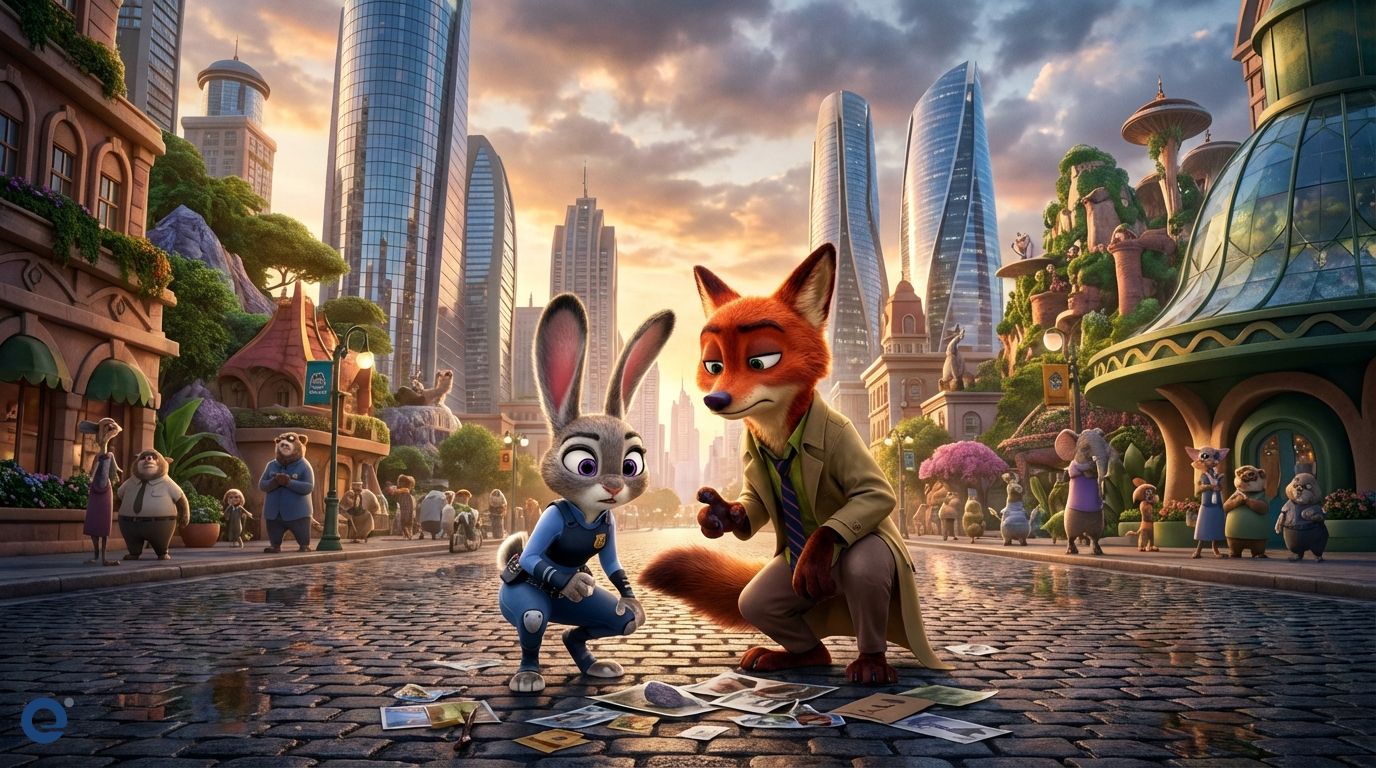
Judy’s chance to prove herself comes with the case of a missing otter, Emmitt Otterton. She seizes the opportunity, but Chief Bogo gives her only 48 hours to solve it. To do so, she needs information, and she realizes Nick was one of the last to see Otterton.
Using her cunning, Judy tricks Nick into helping her by using his tax evasion as leverage. This forces Nick into an unwilling partnership with the bunny cop he initially dismissed. Their dynamic is central to the film.
From suspicion to trust
Initially, Judy and Nick’s relationship is filled with mistrust and bickering. Judy sees Nick as a shifty criminal, and Nick sees Judy as a naive dreamer. However, as they work together, they begin to understand each other better.
They discover they have more in common than they thought. Both have been judged and underestimated based on their species. This shared experience starts to build a bridge between them.
Uncovering a dark conspiracy
As Judy and Nick investigate Otterton’s disappearance, they find he is not the only mammal who has gone missing. All the missing animals are predators who have “gone savage,” reverting to a feral state. This discovery is alarming.
Their investigation leads them through various parts of Zootopia, from the shady dealings of Mr. Big, an arctic shrew crime boss, to a secret facility where the savage predators are being held. The mystery deepens with every clue.
The “Night Howlers” clue
The term “Night Howlers” keeps appearing in their investigation. They initially think these are wolves, but the truth is more complex. The Night Howlers are actually flowers with a potent psychotropic effect on mammals, particularly predators.
They discover that these flowers are being used to make predators go savage. This suggests a deliberate plot to turn the city against its predator population. The conspiracy is bigger than they imagined.
Thematic exploration: Prejudice and stereotypes
One of “Zootopia’s” most praised aspects is its exploration of prejudice and stereotypes. The film uses the predator/prey dynamic to mirror real-world biases based on race, gender, and other social categories. Judy faces prejudice for being a small rabbit, while Nick is stereotyped as untrustworthy because he is a fox.
The movie shows how easily stereotypes can be internalized and perpetuated. Judy herself, despite her good intentions, makes a prejudiced statement about predators during a press conference, causing a rift with Nick and widespread fear.
The impact of words
Judy’s press conference statement, suggesting a biological reason for predators going savage, has immediate and severe consequences. It incites fear and division within Zootopia. Predators become feared and marginalized.
This part of the film highlights the power of words and the responsibility that comes with them, especially from those in authority. It also shows how even well-meaning individuals can harbor unconscious biases.
Thematic exploration: Systemic bias and power
The film also touches upon systemic bias[3] and the abuse of power. The conspiracy to make predators go savage is orchestrated by Assistant Mayor Bellwether, a sheep who feels undervalued and resents the larger, more powerful predators, like Mayor Lionheart.
Bellwether manipulates events to gain power by stoking fear against predators. She uses the “Night Howler” toxin to target them, creating a crisis she can then “solve,” positioning herself as the city’s savior and marginalizing the predator minority.
A sheep in wolf’s clothing
Bellwether’s reveal as the villain is significant. She is a small, seemingly harmless prey animal. Her actions demonstrate that prejudice and the desire for power are not limited to any one group. Anyone can be capable of discrimination and manipulation.
Her plot is a form of systemic oppression, using fear to control the populace and scapegoat a minority group. It’s a powerful commentary on how fear can be weaponized in society.
Thematic exploration: Dreams and perseverance
Despite the heavy themes, “Zootopia” is also a story about dreams and the perseverance needed to achieve them. Judy’s unwavering determination to become a police officer, despite all obstacles, is inspiring. She refuses to give up, even when things seem impossible.
Nick, too, eventually rediscovers his own buried dreams. He realizes he doesn’t have to be defined by stereotypes. Judy’s belief in him helps him see a different path for himself.
“Try everything”
The film’s theme song, “Try Everything” sung by Gazelle (voiced by Shakira), encapsulates this message of hope and resilience. It encourages embracing failure and continuing to strive for one’s goals. Judy embodies this spirit throughout the movie.
She makes mistakes, but she learns from them and keeps trying. Her journey is about more than just becoming a cop; it’s about becoming a better, more understanding individual.
The rich cast of supporting characters
“Zootopia” features a memorable cast of supporting characters who add depth and humor to the story. Chief Bogo, initially an obstacle for Judy, is shown to be a fair leader under his tough exterior. Clawhauser, the cheerful cheetah receptionist at ZPD, is a fan of pop star Gazelle and adds comic relief.
Judy’s parents, Bonnie and Stu Hopps, represent loving but fearful parents who initially discourage Judy’s dreams out of concern for her safety. Their views also evolve throughout the film.
Memorable encounters
Characters like Flash, the incredibly slow sloth working at the DMV, provide some of the film’s funniest moments. Mr. Big, the tiny shrew with a Marlon Brando-esque voice, is a surprisingly complex crime boss. These characters make the world of Zootopia feel rich and alive, as detailed on IMDb.
Each character, no matter how small their role, contributes to the film’s tapestry and its exploration of different personalities and societal roles within Zootopia.
Animation, art direction, and music
The computer animation[4] in “Zootopia” is stunning. The animators paid incredible attention to detail, from the way different animals move to the textures of their fur and the environments they inhabit. The city of Zootopia itself is a visual marvel, with its diverse and imaginative districts.
The character designs are appealing and expressive, allowing for a wide range of emotions. The art direction successfully creates a world that is both whimsical and grounded enough to support the film’s serious themes.
The sound of Zootopia
Michael Giacchino’s score beautifully complements the film’s visuals and emotional beats. The music ranges from upbeat and adventurous to tense and dramatic, effectively enhancing the storytelling. Shakira’s “Try Everything” is an integral part of the film’s optimistic message.
The sound design also adds to the immersion, with the bustling sounds of the city and the distinct vocalizations of the various animal characters.
Box office success and critical reception
“Zootopia” was a massive commercial success, grossing over $1 billion worldwide. It was praised by critics for its animation, voice acting, humor, and, most notably, its timely and nuanced handling of social themes. Many critics considered it one of Disney’s best animated films.
The film resonated with both children and adults. Children enjoyed the talking animals and the adventure, while adults appreciated the deeper messages about prejudice and social justice. Its high rating on Rotten Tomatoes reflects its broad appeal.
A global phenomenon
The movie’s success was global, indicating that its themes were universally relevant. It sparked conversations about bias and discrimination in many countries. The characters of Judy and Nick became incredibly popular.
The film’s ability to be both entertaining and thought-provoking was key to its widespread acclaim. It proved that family films could tackle complex issues meaningfully.
Awards and accolades
Reflecting its critical acclaim, “Zootopia” received numerous awards. It won the Academy Award for Best Animated Feature Film at the 89th Academy Awards. It also received the Golden Globe Award for Best Animated Feature Film and the Critics’ Choice Movie Award for Best Animated Feature, among many others.
These accolades cemented “Zootopia’s” place as a significant achievement in animation and family filmmaking. The recognition highlighted its successful blend of entertainment and social commentary.
The cultural impact and legacy of Zootopia
“Zootopia” has had a lasting cultural impact. It is often used as a tool to discuss prejudice, stereotypes, and systemic bias with younger audiences. The film’s characters and messages continue to resonate years after its release.
It demonstrated that animated films could be powerful vehicles for social commentary, wrapped in an engaging and accessible package. The film encourages viewers to look beyond appearances and challenge their own biases.
Beyond the screen
The film’s influence can be seen in discussions about diversity and inclusion. It provides a framework for understanding complex social dynamics in a way that is understandable for various age groups. The Wikipedia page for Zootopia details more of its impact.
The buddy cop[5] dynamic between Judy and Nick also adds to its appeal, showcasing a friendship that overcomes initial prejudice.
Zootopia 2 and the future
Given the success of the first film, a sequel, “Zootopia 2,” is officially in the works. Fans are eager to see what new adventures await Judy and Nick and how their relationship and the world of Zootopia will be further developed. Zootopia 2 is anticipated by many.
There is much speculation about the plot of the sequel and what new social issues it might explore. The foundation laid by the first film offers many possibilities for further storytelling within this rich and complex world.
What’s next for Judy and Nick?
The end of the first film sees Nick joining the ZPD as the first fox police officer, partnered with Judy. The sequel will likely explore their dynamic as partners and the challenges they face together. It could delve deeper into the societal issues of Zootopia or introduce new ones.
The anticipation for “Zootopia 2” highlights the original film’s enduring popularity and the desire for more stories set in this unique world.
Conclusion: A film that matters
“Zootopia” is more than just a beautifully animated film with talking animals. It is a smart, funny, and deeply relevant story that tackles important social issues with nuance and care. It encourages empathy, understanding, and the courage to challenge stereotypes and fight for a more inclusive world.
The film’s message of “trying everything” and not letting others define you is timeless and inspiring. Judy Hopps and Nick Wilde’s journey is a testament to the power of friendship and the possibility of change, both within individuals and society.
More Information
- Anthropomorphic: Attributing human characteristics or behavior to an animal or object. In “Zootopia,” the animals walk, talk, wear clothes, and have human-like societies.
- Prejudice: Preconceived opinion that is not based on reason or actual experience, often leading to unfair treatment of particular groups of people or, in this case, animals.
- Systemic bias: The inherent tendency of a process to support particular outcomes. In “Zootopia,” it’s shown through the initial limitations placed on Judy and the fear directed towards predators.
- Computer animation: The process of generating animated images using computer graphics. “Zootopia” is a prime example of modern, sophisticated computer animation in filmmaking.
- Buddy cop: A film genre in which two people of very different and conflicting personalities are forced to work together to solve a crime or defeat a common enemy, often learning from each other in the process.